Stop Worshipping Stock Guns: Upgrades Aren’t the Problem — Dumbass Builds Are
Posted by Someone Who Googled Past Page One on May 3rd 2026
“Just Keep Your Gun Stock.”
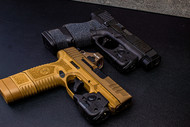
FN Reflex FDE. Glock 26 Gen 5. Purpose-built upgrades, real testing, and no blind parts-swapping.
IronKells Armory | Build Breakdown | Freedom | Craft | Discipline
Quick Forge Map
- Upgrading a Gun Is Not Throwing Parts at It Like a Drunk Raccoon
- Build One: FN Reflex FDE
- Build Two: Glock 26 Gen 5
- The PMM Barrel and Compensator
- Recoil Springs: This Is Where the Stock-Only Crowd Gets Lost
- Stainless Guide Rod and Front-End Weight
- The Glock 17/34 Magazine and X-Grip Sleeve
- Trigger Upgrades: Light Doesn’t Mean Unsafe — Stupid Means Unsafe
- Springs Are Not Magic — They’re Mechanics
- This Glock Spring Setup
- Ammo Matters — Stop Feeding Tuned Guns Trash
- Compensators and Ammo Pressure
- Red Dot vs. Iron Sights
- Red Dot vs. Laser
- Weapon Lights Matter
- Grip Tape: Test It Like Your Hands Actually Sweat
- Magazine Setup Is Recoil Control Too
- All My EDC Guns Are Upgraded — Because I Don’t Fuck Around
- The Stock-Only Crowd Is Half Right — And Still Wrong as Hell
- Don’t Upgrade Everything at Once and Then Cry About Problems
- Carry Guns Need Respect
- IronKells Testing Mindset
- Final Word from the Forge
There’s a phrase in the gun world that gets repeated so much people act like Moses brought it down from Mount Glock on stone tablets:
“Just keep your gun stock.”
And look — sometimes that’s solid advice.
If you don’t know what the hell you’re doing, if you don’t understand how springs, ammo, triggers, connectors, compensators, optics, lights, magazines, grip, and basic function all work together — then yes, keep that bitch stock.
That’s not me being mean.
That’s me trying to keep you from building a $900 malfunction dispenser with a trigger job from Satan’s discount bin.
But here’s where I get pissed.
A lot of people yelling “keep it stock” aren’t saying it because they’re seasoned armorers with thousands of rounds of testing behind them.
They’re saying it because they don’t know how to upgrade a firearm correctly.
They don’t understand slide timing.
They don’t understand spring weight.
They don’t understand primer hardness.
They don’t understand why a comp changes ammo needs.
They don’t understand trigger safety checks.
They don’t understand testing beyond one magazine and a prayer.
So instead of learning, they hide behind the easiest answer:
“Stock is best.”
No, brother.
Stock is safest for people who don’t know what the fuck they’re doing.
That is not the same thing as stock being the only reliable option.
A firearm is a mechanical system. Systems can be improved. Systems can also be ruined by some overconfident jackass with a punch set, a YouTube video, and the mechanical instincts of a wet raccoon.
That’s the difference.
At IronKells Armory, we don’t worship stock guns like factory plastic was kissed by Odin and dipped in holy CLP.
We respect stock guns.
Then we improve them when there’s a damn good reason.
Because stock is fine.
But stock is also boring as hell.
And if I can make a pistol shoot flatter, faster, cleaner, smoother, more accurately, and more comfortably — while still keeping it safe and reliable — then fuck yeah, I’m going to do it.
This blog is about two compact carry pistols we upgraded:
- FN Reflex FDE
- Glock 26 Gen 5
Two different guns.
Two different personalities.
Same rule:
Build with purpose. Test everything. Don’t build stupid shit.
Build Breakdown
Upgrading a Gun Is Not Throwing Parts at It Like a Drunk Raccoon
Let’s clear the smoke.
Upgrading a handgun is not buying every shiny part the internet recommends, dumping it into your pistol, and hoping the recoil gods give you a high five.
That’s how you end up with a gun that looks expensive and runs like a lawn mower full of gravel and bad decisions.
A real upgrade needs a job.
Ask yourself:
- Does this help me see better?
- Does this help me grip better?
- Does this help the gun cycle correctly?
- Does this help me shoot faster without losing control?
- Does this help the trigger feel better without becoming unsafe?
- Does this improve capacity without screwing reliability?
- Does this help carry, control, comfort, speed, or real-world use?
If the answer is no, that part probably belongs in the junk drawer next to stripped screws, mystery springs, and all the other dumb shit we bought because some internet dude said it was “a must-have.”
A good build is not a pile of parts.
A good build is a system.
That system includes:
- Springs
- Ammo
- Trigger setup
- Connectors
- Compensators
- Optics
- Lights
- Lasers
- Grip tape
- Magazines
- Base pads
- Shooter skill
- Actual live-fire testing
If you skip the testing, you didn’t build a carry gun.
You built a decorated paperweight with abandonment issues.
And nobody needs a pistol that runs like it was assembled during a divorce.
Build Breakdown
Build One: FN Reflex FDE
Clean Carry Setup Without Turning It Into a Tactical Tumor
The FN Reflex FDE is already a solid little carry gun.
It’s slim, compact, lightweight, and actually makes sense for concealed carry. With this build, I wasn’t trying to turn it into some giant tacticool brick that needs its own zip code.
The goal was simple:
Make it easier to shoot, easier to control, and more useful — without ruining what makes it a good carry gun.
That’s the difference between upgrading and just bolting shit onto a pistol like you’re decorating a Christmas tree at Bass Pro.
Build Breakdown
FN Reflex FDE Parts List
This Reflex build was upgraded with:
- Holosun 407K-GR-X2 red dot optic
- Streamlight TLR-6 500 Lumens light/laser combo in black
- FN Refelx 18 Round extended magazine
- IronKells Armory lightened internal springs
- mostly FDE layout with the black TLR-6 adding contrast
That’s a clean carry setup.
Nothing ridiculous.
Nothing useless.
Nothing added just to impress strangers in a Facebook comment section.
Just practical upgrades that actually do something.
Forge File
Why This FN Reflex Build Works
The FN Reflex is a micro-compact pistol. That means every part has to earn its damn seat at the table.
You don’t load up a small carry gun with every attachment known to mankind until it weighs more than a cordless drill and prints through your shirt like you’re smuggling a toaster.
You fix the weak points.
The Holosun 407K-GR-X2 red dot optic helps you pick up your sight picture faster once you actually train with it.
A red dot does not make you a better shooter by magic.
It just rewards good fundamentals.
If your presentation sucks, you’ll be fishing for that dot like a drunk man looking for his truck keys in a pasture.
The Streamlight TLR-6 500 Lumens light/laser combo in black gives you a compact light and laser setup. That matters because identifying what’s in front of you is not optional.
You don’t get to guess in the dark like a dumbass.
The light also adds a little weight up front, which can help the pistol feel more planted under recoil. Is it a giant tungsten race-gun weight? No. But on a small carry pistol, every bit of front-end stability helps.
The FN Refelx 18 Round extended magazine gives you more capacity and more grip. That matters on a small gun because tiny grips can suck if you’ve got bigger hands.
More grip means more control.
More control means better follow-up shots.
Better follow-up shots mean better hits.
Better hits mean less chance of sending freedom seeds into places they don’t belong.
And that matters, because missed rounds don’t vanish into Narnia. They go somewhere.
The IronKells Armory lightened internal springs help clean up the feel of the gun, but let’s not be dumb about it:
Lighter doesn’t automatically mean better. Tuned means better. Tested means better. Proven means better.
That’s the difference between building and bullshitting.
Forge File
Build Two: Glock 26 Gen 5
The Little Brick Got Teeth
The Glock 26 Gen 5 is a chunky little bastard.
People underestimate it because it’s short.
That’s their mistake.
The Glock 26 has always had good bones. It’s reliable, proven, compact, and compatible with larger Glock magazines. With the right parts and the right tuning, this thing turns into a nasty little carry gun that shoots flatter, grips better, tracks better, and feels way more serious than its size suggests.
It’s like a bulldog in pistol form.
Short. Ugly-cute. Hard to kill. Full of attitude.
Parts List
Glock 26 Gen 5 Parts List
This Glock 26 Gen 5 build was upgraded with:
- PMM Parker Mountain Machine barrel and compensator plus 5 combo
- Streamlight TLR-6 500 Lumens light/laser combo in black
- Talon Grips black granulate grip tape
- Timney Alpha competition Pivot trigger with internal pivot safety
- Stainless steel guide rod
- IronKells Armory made springs
- 13 lb recoil spring
- 4.5 lb lightened striker spring
- reduced power safety plunger spring
- OEM Glock 17/34 17 round magazine
- X-Grip +5 Mag sleeve
- Strike Industries aluminum extended mag relkease button
- Extended slide lock
- Exteneded slide release
- Ghost Inc. 3.5 lb Avenger connector
- TRUGLO night sight iron sights
That is not a random pile of parts.
That is a full tuning direction.
This build is about:
- Recoil control
- Better grip
- Cleaner trigger feel
- Faster follow-up shots
- Better sight picture
- Better low-light capability
- More capacity
- Better control in the hand
The little brick got teeth.
And yes, it bites.
Forge File
The PMM Barrel and Compensator
The PMM Parker Mountain Machine barrel and compensator plus 5 combo helps reduce muzzle rise by using gas pressure to push the muzzle down.
That makes the gun shoot flatter.
A flatter gun gets back on target faster.
That means faster follow-up shots.
That means better control.
That means less standing there looking surprised while your sights are doing cartwheels.
But a compensator is not just some angry-looking chunk of metal hanging off the barrel so your pistol can look like it lifts weights and drinks black coffee.
A compensator changes how the gun cycles.
When gas gets redirected through the comp, some of the energy that would normally help drive the slide is being used to fight muzzle rise. That means ammo, recoil spring weight, slide speed, grip, and comp design all start mattering more.
Different compensators behave differently because they’re built differently:
- Different port size
- Different number of ports
- Different chamber size
- Different weight
- Different gas efficiency
- Different barrel fit
- Different timing
Some comps run great with factory springs.
Some need tuning.
Some like hotter ammo.
Some choke on weak 115 grain range ammo like a dog trying to swallow peanut butter.
That doesn’t mean comps are bad.
It means you need to know what the fuck you’re doing.
Tuning Notes
Recoil Springs: This Is Where the Stock-Only Crowd Gets Lost
A stock Gen5 Glock 17/G34 recoil spring setup is generally around 17 lb.
A Gen5 Glock 19 is commonly around 18–19 lb because the shorter slide needs a little more spring force.
The Glock 26 uses its own shorter dual recoil spring assembly from the factory, but the tuning concept is the same:
Spring weight controls slide timing.
This Glock 26 build uses:
- 13 lb recoil spring
Why?
Because this comped setup needs the slide to cycle correctly with the ammo I trust.
That does not mean every Glock needs a 13 lb spring.
Don’t be that guy.
That guy is why warning labels exist.
The goal is not to make everything as light as possible. The goal is to make the gun run right.
A recoil spring that is too heavy can cause:
- Weak ejection
- Stovepipes
- Failure to lock back
- Short-stroking
- Sluggish cycling
- Muzzle dip when the slide slams forward
A recoil spring that is too light can cause:
- Excessive slide speed
- Harsh frame impact
- Feeding issues
- Slide outrunning the magazine
- Wild ejection
- More wear with hot ammo
That’s why you test.
You don’t guess.
Guessing is for gas station sushi, bad tattoos, and people who think “I saw it on Reddit” counts as gunsmithing.
Not carry guns.
Forge File
Stainless Guide Rod and Front-End Weight
The stainless steel guide rod adds strength and a little weight up front.
That helps the gun feel more planted.
The Streamlight TLR-6 500 Lumens light/laser combo in black also adds useful weight toward the front of the gun.
A weapon light helps you see what you’re dealing with.
It also adds front-end weight, which can help with recoil control.
That’s a win.
Especially on a small gun like the Glock 26, every little bit of control matters.
Is it going to turn a G26 into a 12-pound benchrest rifle? No. Don’t be dramatic.
But small advantages stack.
That’s how you build a gun that feels better, tracks better, and runs like it has a job to do.
Control
The Glock 17/34 Magazine and X-Grip Sleeve
For this Glock 26 build, we’re not relying only on the tiny little baby magazine.
We’re using:
- OEM Glock 17/34 17 round magazine
- X-Grip +5 Mag sleeve
That matters.
Forge File
More Capacity
A 17-round magazine gives you more rounds on board.
More rounds means more options before you need to reload.
Simple.
Nobody ever got into a serious moment and said, “Damn, I wish I had less ammo.”
Control
Better Grip
The larger magazine gives your hand more to hold onto.
That means:
- Better recoil control
- Better leverage
- Better comfort
- Faster follow-up shots
- Better control under speed
A short little grip can be harder to manage, especially if you’ve got bigger hands.
The bigger magazine helps lock the gun into your hand better.
That means the gun moves less.
When the gun moves less, you shoot better.
That’s not rocket science.
That’s caveman physics with expensive parts.
Forge File
Cleaner Fit
The X-Grip +5 Mag sleeve fills the gap between the Glock 26 frame and the full-size magazine.
Without that sleeve, extended mags can look and feel like somebody shoved a broom handle into a pistol and called it tactical.
That’s ugly.
And I hate ugly when it’s also avoidable.
The sleeve makes it cleaner, more comfortable, and more intentional.
That’s the point.
If we build it, it needs to look right and work right.
No half-assed goblin builds.
No “good enough” duct-tape energy.
No pistol looking like it was assembled by a raccoon behind a pawn shop.
Trigger Talk
Trigger Upgrades: Light Doesn’t Mean Unsafe — Stupid Means Unsafe
Now let’s talk about the part that makes people cry in the comments.
This Glock build uses:
- Timney Alpha competition Pivot trigger with internal pivot safety
- Ghost Inc. 3.5 lb Avenger connector
- 4.5 lb lightened striker spring
- reduced power safety plunger spring
Yes, I know Timney calls it a competition trigger.
I can read.
Gold star for everybody.
I also know what I like. Also this is a customers gun so what they want, they get.
I prefer a light trigger pull. I shoot light triggers better. I’ve trained with them. I understand them. I trust them because I test them.
And yes, I prefer them even on my EDC guns.
That does not mean every person should do the same thing.
If you don’t have trigger discipline, mechanical understanding, and enough live-fire time to prove the setup, don’t copy my build just because it looks badass.
A light trigger demands respect.
A light trigger demands skill.
A light trigger demands safety checks.
A light trigger demands testing.
The problem is not light triggers.
The problem is untrained hands, lazy installs, and people acting like “it feels good dry firing” means it’s ready to carry.
That’s not confidence.
That’s dumbassery wearing a holster.
Trigger Talk
Carry Triggers Still Have to Be Safe
A carry trigger must pass safety checks.
Every damn time.
That means:
- Trigger safety works
- Firing pin safety works
- Drop safety works
- Trigger resets correctly
- Striker engagement is safe
- Gun does not fire unless the trigger is intentionally pressed
- Gun does not fire when jarred, bumped, or handled hard
- Gun ignites the ammo you actually carry
- Gun runs dirty, hot, and under real shooting conditions
If it does not pass, it does not carry.
I don’t care how smooth it feels.
I don’t care if angels sing when the trigger breaks.
I don’t care if it feels like butter sliding across a bald eagle’s back.
If it isn’t safe, it’s not going in a carry gun.
A light trigger that is unsafe is not an upgrade.
It’s a lawsuit with night sights.
But a properly installed, properly tested, properly understood light trigger in the hands of a disciplined shooter?
That can absolutely be faster, cleaner, more accurate, and more controllable.
That’s not reckless.
That’s doing the damn work.
Tuning Notes
Springs Are Not Magic — They’re Mechanics
People hear “internal springs” and act like we’re doing dark magic under the slide with goat candles and forbidden Glock scrolls.
Relax.
Springs are not witchcraft.
They’re mechanical parts with mechanical jobs.
A recoil spring controls slide speed and helps return the slide into battery.
A striker spring controls striker energy and affects trigger pull.
A trigger spring affects trigger return and reset feel.
A safety plunger spring affects the feel of the trigger press and safety plunger movement.
A magazine spring controls how reliably rounds rise into feeding position.
Change one spring, and the whole system can feel it.
That is why you don’t just throw springs in a gun because some dude online said, “Bro, it runs flawless.”
Flawless after what?
One magazine?
Standing still?
Perfect grip?
Clean gun?
Soft ammo?
No stress?
That ain’t testing.
That’s flirting.
And I don’t flirt with carry guns.
I make them prove themselves.
Tuning Notes
This Glock Spring Setup
This Glock 26 build uses:
- IronKells Armory made springs
- 13 lb recoil spring
- 4.5 lb lightened striker spring
- reduced power safety plunger spring
- Ghost Inc. 3.5 lb Avenger connector
The 13 lb recoil spring helps the comped setup cycle correctly.
The 4.5 lb lightened striker spring helps reduce trigger pull, but it also makes ammo choice more important.
The reduced power safety plunger spring helps smooth the trigger press.
The Ghost Inc. 3.5 lb Avenger connector changes the break and feel of the trigger.
All of those parts work together.
That’s the point.
But if you lighten the striker spring and start getting light primer strikes, don’t stand there blinking like the gun betrayed you.
That’s the system telling you something.
Listen to the gun.
The gun is usually smarter than your ego.
And ego is the cheapest part in most bad builds.
Range Notes
Ammo Matters — Stop Feeding Tuned Guns Trash
Ammo is not just “whatever 9mm was cheapest.”
Not when you start tuning triggers, springs, and compensators.
With a compensator, ammo pressure and gas matter.
A comp needs gas to work.
Weak ammo can cause problems because there may not be enough energy to drive the slide properly after the comp redirects gas.
That’s why cheap 115 grain range ammo can be hit or miss in comped guns.
Some runs fine.
Some short-strokes.
Some stovepipes.
Some makes you invent new curse words in front of innocent bystanders and possibly a church group.
Range Notes
My Preferred Carry Ammo
For defensive ammo, I personally prefer:
- Federal HST 9mm 124 grain
- Federal HST 9mm 147 grain
Federal HST is proven, consistent, and trusted for good reason.
Federal primers are also known for being softer and easier to ignite compared to some harder-primer ammo.
That matters when you’re running a lightened striker spring.
Because a light trigger is cool.
A click instead of a bang is not.
That’s not “a minor issue.”
That’s your soul briefly leaving your body and asking for management.
Forge File
Soft Primers vs. Hard Primers
Primer hardness matters.
A lightened striker spring reduces striker force.
That means hard primers can expose ignition problems.
Harder primers can show up in:
- Some NATO-spec ammo
- Some Winchester service/NATO-style ammo
- Some Fiocchi
- Some Sellier & Bellot
- Some European or military-style loads
That doesn’t mean those brands are trash.
It means your gun may not like them with a lightened striker spring.
If your gun runs Federal HST perfectly but starts clicking on harder primer ammo, that’s not a mystery.
That’s primer hardness meeting spring tuning.
And a click instead of a bang in a defensive situation?
That’s not “oops.”
That’s a bad day with hot sauce on it.
Test your actual carry ammo.
Not one magazine.
Not “it ran once.”
Actually test it.
If your carry gun has only eaten 17 rounds of your carry ammo, you don’t have a proven setup.
You have a hopeful relationship.
And hope is not a reliability standard.
Range Notes
Compensators and Ammo Pressure
A compensator works by redirecting gas.
More useful gas usually means the comp works better.
That’s why hotter 124 grain +P or full-power loads can make a comp perform better than weak 115 grain range ammo.
A comped gun may prefer:
- 124 grain defensive ammo
- 124 grain +P
- 135 grain +P
- 147 grain standard pressure
- 147 grain +P depending on the gun and comp
A 147 grain round can feel softer because it has more of a push than a snap.
But some 147 grain loads may not generate as much gas pressure for the comp as a hotter 124 +P load.
So don’t marry an ammo choice because the internet told you to.
Shoot it.
Test it.
See what your gun actually runs best.
The gun gets the final vote.
Not the comments section.
The comments section also thinks steel targets at seven yards are a personality trait, so maybe don’t let it run your life.
Sight & Light
Red Dot vs. Iron Sights
Iron sights are simple, durable, and old-school.
You line up the front sight, rear sight, and target. They don’t need batteries. They don’t care about electronics. They just sit there and do their job like an old ranch dog that’s seen some shit.
Red dots are different.
A red dot or green dot optic gives you an aiming point inside the optic window. Instead of lining up front sight, rear sight, and target, your eye can stay more focused on the target.
A red dot can help with:
- Faster sight acquisition
- Better accuracy at distance
- Better target focus
- Faster transitions
- Cleaner recoil tracking
- Awkward shooting positions
- Easier aiming for aging eyes
But a dot doesn’t make you good.
If your grip sucks, your trigger press sucks, and your presentation sucks, congratulations — now you suck with a glowing dot.
Technology didn’t fail you.
You failed loudly with accessories.
Train.
That’s why the Glock build still has:
- TRUGLO night sight iron sights
Backup irons matter.
Batteries die.
Glass gets dirty.
Electronics fail.
Life is rude like that.
Sight & Light
Red Dot vs. Laser
A red dot and a laser are not the same damn thing.
A red dot optic shows an aiming point inside the optic window.
A laser projects a visible aiming point onto the target or surface.
A red dot is usually better as a primary sighting system.
A laser can help in certain situations:
- Low light
- Close range
- Awkward angles
- Unconventional positions
- When you cannot get a perfect sight picture
But a laser should not become a crutch.
If you cannot shoot without the laser, you don’t need more gear.
You need more training.
And maybe a mirror.
Because the problem might be holding the gun.
Sight & Light
Green Laser vs. Red Laser
Green lasers are usually easier to see, especially in brighter conditions.
Red lasers usually use less battery and still work well in low light.
Simple breakdown:
- Green laser: easier to see, usually more battery demand
- Red laser: usually better battery life, can be harder to see in bright light
Both can be useful.
Neither one fixes bad shooting.
A laser on a bad shooter is just a PowerPoint presentation of poor fundamentals.
Sight & Light
Weapon Lights Matter
A weapon light is not just there so your gun looks cool in a photo.
A weapon light helps you identify what you are dealing with.
That is serious.
You cannot responsibly deal with something you cannot clearly identify.
A weapon light helps with:
- Target identification
- Low-light visibility
- Movement in dark areas
- Keeping both hands on the gun when needed
- Reducing guesswork
- Adding front-end weight for recoil control
That front-end weight matters.
A light can help the pistol feel more planted, especially on a smaller gun. It adds weight where weight helps — toward the muzzle.
But a weapon light does not give you permission to point your gun at everything you want to see.
You still need discipline.
You still need judgment.
You still need a handheld light.
Gear does not replace a brain.
Sadly, brains are not included in the box.
If they were, half the internet would still forget to install them correctly.
Control
Grip Tape: Test It Like Your Hands Actually Sweat
Grip tape is one of those upgrades people ignore because it isn’t sexy.
Good.
Some of the best upgrades are boring until they start saving your ass.
Grip controls everything.
Grip affects:
- Recoil control
- Trigger control
- Return-to-target speed
- Follow-up shots
- Accuracy under speed
- Confidence under stress
On small guns like the Glock 26, grip matters even more because there is less frame to hold onto.
That is why the Glock has:
- Talon Grips black granulate grip tape
But don’t assume all grip tape is good.
I’ve tried plenty of brands.
Some feel great dry and then turn slick once your hands get sweaty.
That’s useless.
Test your grip tape like real life exists.
Try it with:
- Dry hands
- Sweaty hands
- Lotion on your hands
- Dusty hands
- Hot hands
- Tired hands
- After multiple magazines
- During fast shooting
If it only works when your hands are perfectly clean and dry, it ain’t good enough.
That’s not grip.
That’s decorative sandpaper cosplay.
And I don’t need my carry gun wearing arts-and-crafts supplies.
I need the damn thing to stay planted.
Control
Magazine Setup Is Recoil Control Too
Magazines are not just ammo holders.
They affect:
- Capacity
- Feeding
- Grip
- Comfort
- Concealability
- Recoil control
- Follow-up shot speed
The Glock 26 with:
- OEM Glock 17/34 17 round magazine
- X-Grip +5 Mag sleeve
gives you more rounds and more grip.
That larger magazine lets you hold onto the gun better.
That means better recoil control.
Better recoil control means faster follow-up shots.
Faster follow-up shots mean better accuracy under speed.
Better accuracy matters because missed rounds don’t just disappear into the universe.
They go somewhere.
And if you care about being responsible, you should care about building a gun you can control.
That’s why this stuff matters.
Not because it looks cool.
Although yeah, it does look cool.
And I’m not going to pretend looking cool sucks.
Looking cool is fine.
Looking cool while the gun actually runs?
Fuck yeah.
That’s the whole point.
Forge File
All My EDC Guns Are Upgraded — Because I Don’t Fuck Around
Here’s the part that makes the stock-only crowd start sweating through their cargo shorts.
All my EDC guns are upgraded.
Not most.
All.
I rotate between a lot of carry guns, and they are maxed out because that is how I like my tools built.
My carry guns usually have:
- Lights
- Optics
- Improved triggers
- Grip enhancements
- Tuned springs
- Compensators
- Extended controls
- Better sights
- Magazine setups
- Other performance parts
A lot of them are built almost like competition-style setups, but with a real carry mindset.
That does not mean fragile.
That does not mean unsafe.
That does not mean reckless.
It means I build them, tune them, shoot them, test them, cuss at them if needed, fix what needs fixing, and work the bullshit out before I trust them.
I have put thousands and thousands of rounds through these setups.
When they are properly built and properly tested, I have not had:
- Reliability issues
- Unsafe triggers
- Drop-safety problems
- Light primer strike problems with the ammo I trust
That doesn’t happen because I got lucky.
That happens because I do the work.
The ammo gets tested.
The springs get tuned.
The trigger gets checked.
The magazines get proven.
The grip gets tested.
The whole setup earns its spot.
I don’t carry upgraded guns because I want to look cool.
I carry upgraded guns because I shoot them better.
That means:
- Better accuracy
- Better speed
- Better control
- Better confidence
- Less wasted movement
- Less chance of putting rounds where they don’t belong
That matters.
And I’m not apologizing for wanting my tools tuned to a higher level.
I’m not carrying a life-saving tool because it makes some internet hall monitor comfortable.
I’m carrying what I’ve built, tested, and proven.
Period.
Forge File
The Stock-Only Crowd Is Half Right — And Still Wrong as Hell
The stock-only crowd is right about one thing:
Bad upgrades can cause problems.
No argument.
They are also right that carry guns need reliability.
Again, no argument.
They are right that people should not blindly throw parts into a defensive pistol.
Correct.
Gold star. Juice box. Everybody clap.
But they are wrong when they act like stock is the only trustworthy option.
That is fear dressed up as wisdom.
A stock pistol is a factory compromise.
It is built to work for a broad range of people, ammo, budgets, liability concerns, and conditions.
That is good.
But it does not mean it is perfect for you.
A properly tuned pistol can be better.
A better trigger can help you shoot cleaner.
A better recoil system can help the gun track flatter.
A better optic can help you aim faster.
Better grip can help you control recoil.
A better magazine setup can improve comfort and capacity.
A weapon light can help you identify what’s in front of you.
None of that is reckless when it is done correctly.
Reckless is pretending one answer fits everybody.
That’s not wisdom.
That’s laziness with a belt clip.
Forge File
Don’t Upgrade Everything at Once and Then Cry About Problems
This is where new builders screw themselves sideways.
They install everything at once:
- Trigger
- Connector
- Striker spring
- Recoil spring
- Safety plunger spring
- Compensator
- Optic
- Light
- Grip tape
- Extended mag release
- Magazine extension
- Base pad
Then the gun has an issue.
Now they have no idea what caused it.
Congratulations.
You built yourself a mystery novel with recoil.
The smarter way:
- Install with purpose.
- Function check.
- Test.
- Take notes.
- Change one variable at a time when possible.
- Test again.
- Confirm with your real carry ammo and real magazines.
That is how you learn the gun.
That is how you become a builder instead of a parts-swapper.
Because if your gun fails and your only troubleshooting method is “well shit,” you’re not tuning.
You’re guessing with accessories.
Forge File
Carry Guns Need Respect
Range toys can be wild.
Competition guns can be tuned to the edge.
Carry guns need respect.
If a gun may be used to protect life, reliability comes first.
Always.
Test the gun with:
- Your actual carry ammo
- Your actual magazines
- Your actual optic
- Your actual light
- Your actual laser, if used
- Your actual grip tape
- Your actual spring setup
- Your actual trigger setup
- Your actual holster setup
- Your actual shooting grip
Especially when using:
- Compensators
- Reduced power striker springs
- Lighter recoil springs
- Trigger kits
- Connectors
- Magazine extensions
- Base pads
- Weapon lights
- Lasers
- Optics
- Guide rods
- Internal spring changes
None of those parts are automatically bad.
They just need to prove themselves.
A pistol that feels amazing but fails when it matters is not upgraded.
It is decorated.
And decoration belongs on a Christmas tree, not your defensive pistol.
Unless your defensive plan is to mildly inconvenience an attacker with festive disappointment.
Forge File
IronKells Testing Mindset
Before trusting an upgraded carry gun, test the whole system.
Not just the part.
The whole damn system.
Test:
- Defensive ammo
- Range ammo
- Different bullet weights
- Magazine changes
- Light installed
- Optic installed
- Comp installed
- Grip tape with sweaty hands
- Grip tape with lotion on your hands
- One-handed shooting
- Fast follow-up shots
- Slide lock on empty
- Primer ignition
- Ejection pattern
- Feeding reliability
- Trigger reset
- Safety function
- Dirty gun performance
Watch what the gun tells you.
Weak ejection? Pay attention.
Failure to lock back? Pay attention.
Light primer strike? Pay attention.
Failure to feed? Pay attention.
Grip slipping under sweat? Pay attention.
Comp loosening? Pay attention.
Dot not tracking right? Pay attention.
The gun is talking.
Because the machine does not care about your feelings.
It only cares about physics.
And physics is undefeated.
Final Word
Final Word from the Forge
The FN Reflex FDE and Glock 26 Gen 5 show two different ways to upgrade a carry pistol.
The FN Reflex stays clean, compact, and practical.
The Glock 26 goes harder — comped, tuned, gripped, lit, sighted, and set up with more capacity and better control.
Different guns.
Different paths.
Same rule:
Build with purpose. Test everything. Learn your weapon.
Do not be afraid of upgrades.
Be afraid of ignorance.
Be afraid of bad installs.
Be afraid of cheap parts, no testing, and loud opinions from people who have never actually done the work.
At IronKells Armory, we are not here to build safe queens, internet trophies, or soft-handed bullshit.
We are here to build guns that run.
No fluff.
No fake expert crap.
No blind parts-swapping.
No worshipping stock guns.
No boring-ass copy-paste advice from people who think confidence is louder than competence.
Just better knowledge, better builds, and gear that earns its damn place.
Fuck yeah. That’s the forge.