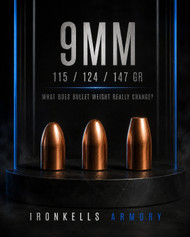
9mm Bullet Weight Explained: 115gr vs. 124gr vs. 147gr
Posted by Honestly... we're not really sure anymore. on Aug 7th 2026
IronKells Armory • The IronFeed • Ammunition Education
9mm: 115 vs. 124 vs. 147 Grain
What bullet weight actually changes and what the number on the box cannot tell you
All three are 9mm Luger. All three can be useful. The difference is not a simple ladder from weak to powerful. Bullet weight interacts with velocity, construction, barrel length, firearm design, and the job you expect the ammunition to perform.
Updated August 7, 2026
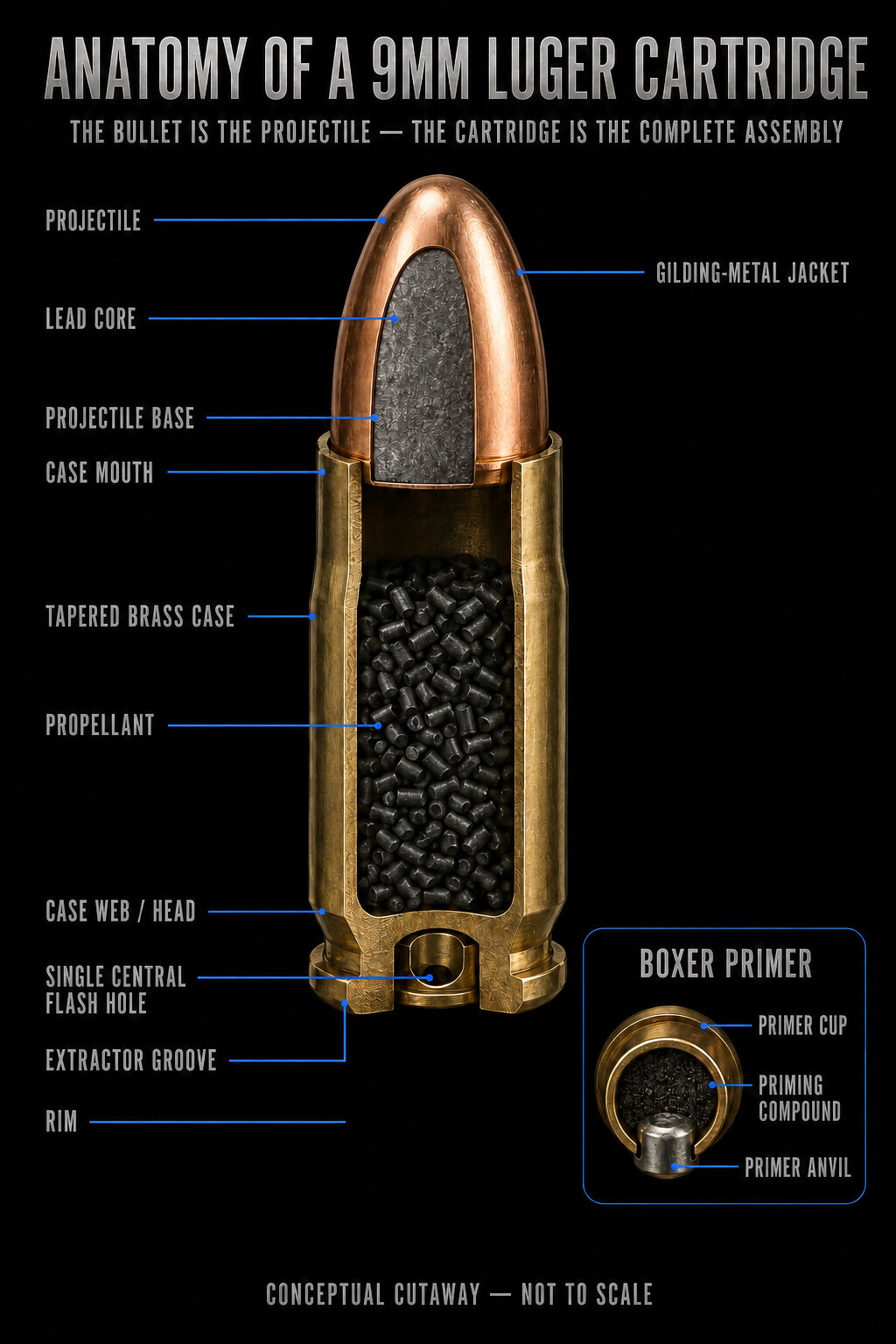
Pros & Cons | Recoil | Cost | Best Fit
Walk into almost any ammunition aisle and you will see 9mm boxes marked 115 grain, 124 grain, and 147 grain. The lazy explanation says 115 is fast, 124 is balanced, and 147 hits harder. The first two ideas can describe a general tendency. The last one can be flat wrong.
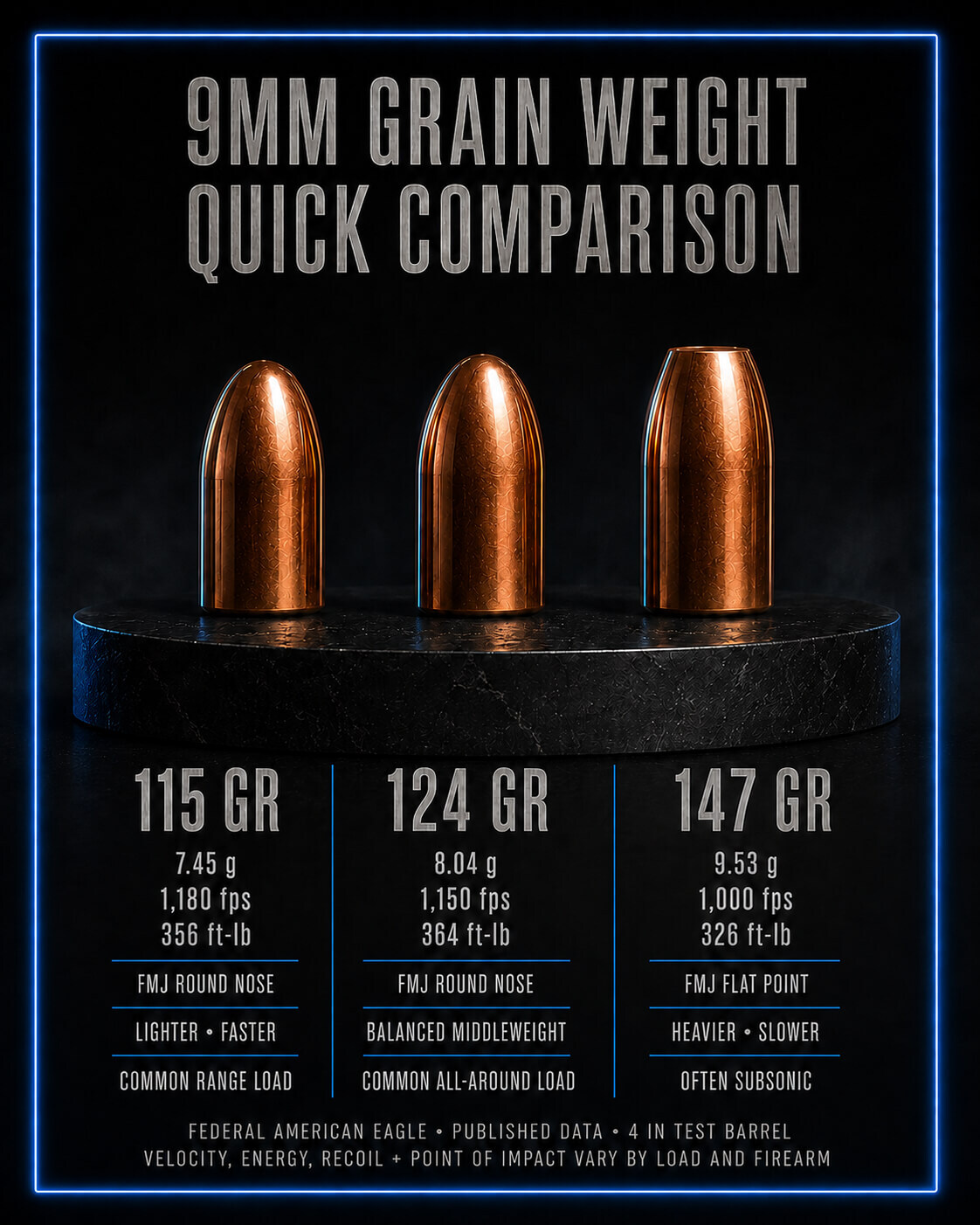
To make the comparison honest, this guide uses three loads from the same Federal American Eagle product family: AE9DP 115gr FMJ, AE9AP 124gr FMJ, and AE9FP 147gr FMJ. Federal publishes all three as target-shooting loads and lists velocity from the same 4-inch test-barrel length. That controls more variables than mixing random brands, bullet designs, pressure levels, and barrel lengths.
The main idea: Grain measures projectile mass. It is not a power rating, powder charge, recoil score, penetration promise, or accuracy grade.
First: What Does “Grain” Mean?
A grain is a unit of mass. One grain equals approximately 64.8 milligrams, and 7,000 grains equal one avoirdupois pound. On a box of ammunition, the grain number normally identifies the projectile’s weight—not the amount of propellant inside the case.
115 grain
Approximately 7.45 g
124 grain
Approximately 8.04 g
147 grain
Approximately 9.53 g
All three projectiles remain nominally the same 9mm diameter. Extra mass can come from changes in length, internal construction, material, nose profile, or a combination of those factors. Grain weight alone does not reveal the exact dimensions.
The Apples-to-Apples Federal Comparison
| Load | Projectile | Published velocity | Calculated energy | Published use |
|---|---|---|---|---|
| Federal AE9DP | 115gr FMJ | 1,180 fps | Approximately 356 ft-lb | Target shooting |
| Federal AE9AP | 124gr FMJ | 1,150 fps | Approximately 364 ft-lb | Target shooting |
| Federal AE9FP | 147gr FMJ / flat-point profile | 1,000 fps | Approximately 326 ft-lb | Target shooting |
How to read the table: Velocity is Federal’s published value from a 4-inch test barrel. Energy is calculated from projectile weight and published velocity, rounded to the nearest foot-pound. Your firearm can produce different velocity.
Myth killed: The heaviest projectile does not automatically produce the most muzzle energy. In this controlled comparison, the 124gr load calculates slightly higher than both the 115gr and 147gr loads.
115, 124 and 147 Grain in Plain English
115 grain
Light, fast and widely available
Strengths: Common range weight, broad availability, often aggressively priced, and typically higher velocity within a comparable product family.
Limitations: Can feel sharper in some firearms, is commonly supersonic, and should not be treated as automatically softer or weaker.
124 grain
The practical middleweight
Strengths: A useful all-around training weight, common in duty-style offerings, and the highest calculated muzzle energy in this exact Federal comparison.
Limitations: May cost slightly more than bulk 115gr, is usually still supersonic, and is not automatically the most accurate load in your firearm.
147 grain
Heavy, slow and commonly subsonic
Strengths: Often selected for suppressed shooting because many 147gr loads stay below the speed of sound from common pistol barrels; some shooters prefer its recoil impulse.
Limitations: Often costs more, has lower velocity and more arcing trajectory, and flat-point profiles may feed differently in ammunition-sensitive firearms.
Which One Recoils Less?
There is no honest universal winner. Recoil depends on projectile momentum, propellant gas, firearm mass, slide or bolt speed, recoil-spring system, grip, compensator or suppressor, and the pressure curve of the exact load.
Shooters often describe lighter, faster loads as having a quicker or sharper impulse and heavier, slower loads as having a longer push. That is a useful description of perception—not a law of physics stamped onto every ammunition box. A specific 147gr load can produce more total recoil than a mild 115gr load, even if it feels less abrupt.
The real test: Fire the candidate loads through your firearm. Watch reliability, split times, point of impact, group size, and how quickly the sights return. Your hands get a vote.
Why 147gr Is Popular With Suppressors
A suppressor reduces muzzle blast. It cannot erase the flight crack made by a projectile traveling faster than sound. A 147gr 9mm load is commonly driven slower than lighter 9mm loads, which makes it easier for manufacturers to keep below the local speed of sound while maintaining enough momentum to operate many common firearms.
Federal publishes AE9FP at 1,000 fps from a 4-inch test barrel, which is below ordinary sea-level speed-of-sound figures. Actual velocity still changes with the firearm, barrel length, ammunition lot, temperature, and atmospheric conditions. “147 grain” is therefore a clue—not a permanent guarantee that every shot from every barrel remains subsonic.
Which Weight Is Usually Cheapest?
Across the broader market, 115gr FMJ is often the cheapest and easiest 9mm range ammunition to find. It is produced in huge volume and commonly anchors bulk-ammunition promotions. The 124gr category is also widely available and may cost the same or slightly more. Heavy 147gr loads often carry a premium because of projectile material, production volume, specialty positioning, or subsonic demand.
That tendency is not a rule. When checked on August 7, 2026, Federal listed all three American Eagle 50-round boxes used in this comparison at the same $19.99 direct price. Retail sales, case pricing, shipping, and availability can reverse the usual order on any given day.
Smart buying: Compare cost per round within the same bullet type and pressure level. A cheap FMJ training load is not a substitute for a properly selected defensive or competition load merely because the grain number matches.
What Grain Weight Cannot Tell You
Barrel length, chamber, ammunition design, temperature, and lot variation matter.
Standard-pressure, +P, and other load differences are separate from projectile weight.
Nose profile, cartridge overall length, firearm geometry, magazine, and recoil system matter.
A firearm may group one load better than another regardless of the grain number.
Bullet construction and impact velocity control terminal behavior. FMJ and JHP are different tools.
Projectile weight is one variable inside the complete firearm-ammunition system.
Which Weight Should You Buy?
| Your priority | Strong starting point | Why |
|---|---|---|
| Lowest-cost general range practice | 115gr FMJ | Usually the broadest selection and strongest bulk pricing. |
| General-purpose training | 124gr FMJ | Practical middleweight and common training choice. |
| Suppressed use with less sonic crack | Purpose-selected 147gr subsonic load | Heavy 9mm is commonly loaded below the speed of sound. |
| Match your defensive ammunition’s feel and point of impact | Same weight and similar product intent | Weight alone is insufficient, but matching it is a logical starting variable. |
| Best accuracy or reliability | Test several quality loads | Your firearm decides. Internet strangers do not get custody of your chamber. |
Quick Questions
Is 147gr always subsonic?
No. Many 147gr 9mm loads are subsonic from common pistol barrels, but actual velocity depends on the exact load, firearm, barrel and conditions.
Does 115gr have less recoil?
Not automatically. It may feel quicker or sharper, while a heavier load may feel more like a push. Compare exact loads in the same firearm.
Is 124gr the best all-around 9mm?
It is a strong middleweight starting point, not a universal champion. Reliability, accuracy, construction, cost and intended use still decide the winner.
Can any 9mm firearm shoot all three weights?
A firearm marked for 9mm Luger is generally designed around compliant 9mm Luger ammunition, but individual firearms can show preferences or reliability differences. Follow the firearm manufacturer’s ammunition guidance and test your chosen load.
The IronKells Bottom Line
Choose 115gr when affordable, widely available range ammunition is the mission. Start with 124gr when you want a practical middleweight. Look closely at 147gr when suppressed shooting or a heavier recoil impulse matters.
Then stop staring at the grain number and evaluate the complete load: construction, pressure, published velocity, barrel length, reliability, accuracy, cost, and actual purpose.
The number on the box starts the conversation. Your firearm finishes it.
Receipts and official references
Published specifications were checked August 7, 2026. Manufacturer pages and prices can change. Energy values in this article were calculated from Federal’s published projectile weights and velocities.
[1] Federal — American Eagle 9mm Luger 115gr FMJ, AE9DP
[2] Federal — American Eagle 9mm Luger 124gr FMJ, AE9AP
[3] Federal — American Eagle 9mm Luger 147gr FMJ, AE9FP
[4] Federal — 2026 product catalog and bullet-style abbreviations
[5] SAAMI — Centerfire pistol and revolver standards information
[6] Federal — Bullet-weight fundamentals and velocity tendency
Disclaimer: This article provides general education. It is not a replacement for the firearm or ammunition manufacturer’s instructions. Specifications, prices and availability change. Use only ammunition appropriate for your firearm, wear proper eye and hearing protection, and follow all range and safety rules.