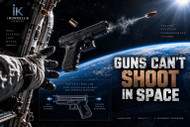
Guns Can't Shoot in Space
Posted by Mr. GunBuster on Sep 29th 2026
IronKells Armory | GunBusters
Guns Can't Shoot in Space
No atmosphere. No oxygen. No gravity. So a gun is useless in space, right? Not even close. Modern ammunition carries the chemistry needed to burn its own propellant, recoil still obeys Newton, and an actual Soviet cannon was fired in Earth orbit. Space doesn't stop the gun from working — it changes almost everything around the shot.
Verdict
BUSTED.
A conventional cartridge does not need oxygen from Earth's atmosphere to fire. Smokeless propellant contains the chemical ingredients needed for combustion, so a functioning firearm can discharge in vacuum. The stranger questions are what happens afterward: recoil moves the shooter or spacecraft, sound does not propagate normally through open vacuum, the projectile follows orbital mechanics instead of ordinary Earth-range ballistics, and heat, lubrication and material behavior become much bigger engineering concerns.
The Claim
“A gun can't fire in space because there's no oxygen.”
It sounds logical if you think gunpowder works like:
wood burning in a campfire.
Take away the atmosphere.
Take away oxygen.
Fire goes out.
Therefore:
gun doesn't fire.
The problem is that smokeless firearm propellant isn't waiting on the atmosphere to provide its oxygen.
Smokeless Powder Does Not Need Outside Oxygen
Modern firearm cartridges are self-contained chemical systems.
A typical cartridge contains:
- Primer
- Propellant
- Projectile
- Cartridge case
SAAMI defines modern smokeless powder as primarily:
- Nitrocellulose in single-base propellant
- Nitrocellulose plus nitroglycerin in double-base propellant
More importantly for this myth, SAAMI explicitly states:
oxygen from the air is not necessary for smokeless-powder combustion.
The material contains sufficient chemically bound oxygen to sustain its rapid burn when properly ignited.
That's why propellant can burn inside a sealed firearm chamber in the first place.
The atmosphere outside the barrel isn't providing the oxygen that launches the bullet.
The Firing Chain Doesn't Need an Atmosphere
Primer → Propellant → High-Pressure Gas → Projectile
The primer supplies the ignition source.
The propellant supplies the energetic chemical reaction.
The expanding gases supply pressure.
The chamber and barrel direct that pressure into accelerating the projectile.
None of those steps requires Earth-normal air outside the gun.
The Rocket Analogy Is Actually Pretty Good
A rocket doesn't need atmospheric oxygen either.
NASA explains that rocket propulsion carries both:
- Fuel
- An oxidizer
The chemistry happens inside the propulsion system and hot gas is expelled to produce thrust.
A firearm isn't a rocket engine, but the useful comparison is:
both carry the chemical ingredients needed for their energetic reaction.
Neither needs to suck oxygen out of the surrounding atmosphere to function.
Recoil Doesn't Disappear in Space
This is where Newton shows up.
NASA actually uses firearm recoil as a textbook example of Newton's Third Law.
Bullet and propellant gas accelerate one direction.
Gun receives momentum in the opposite direction.
On Earth, your body transfers much of that recoil into:
- Your hands
- Your shoulders
- Your stance
- The ground
A freely floating astronaut doesn't have the ground underneath them.
So the same recoil changes the astronaut's own motion.
The shot becomes a tiny propulsion event.
Would the Gun Launch an Astronaut Across Space?
Not like the movies.
The astronaut has vastly more mass than the bullet.
So the bullet leaves quickly while the person moves backward slowly.
But:
slow movement matters when there's nothing underneath you to stop it.
If the recoil impulse doesn't pass cleanly through the shooter's center of mass, it can also create:
rotation.
So an untethered astronaut could begin drifting backward, spinning, or both.
Space didn't make recoil stronger. It removed the ordinary support that keeps the shooter planted.
Another Myth Inside the Myth
Orbit Is Not “No Gravity”
The original Forge File used “no gravity” too loosely.
That's getting fixed.
Astronauts floating around Earth are not floating because Earth's gravity disappeared.
At typical low-Earth-orbit altitude, Earth's gravitational pull is still roughly:
about 90% of surface gravity.
Astronauts feel weightless because:
they and their spacecraft are falling around Earth together.
That's orbital free fall — not gravity being switched off.
What Happens to the Bullet in Deep Space?
Take the cleanest hypothetical first:
You're far from planets, moons or other major gravitational sources.
There's essentially no atmosphere.
The projectile leaves the barrel.
Now there is:
- No meaningful aerodynamic drag
- No wind
- No atmosphere creating ordinary ballistic drag
Newton's First Law takes over.
Absent another meaningful force, the projectile keeps moving with essentially constant velocity.
It doesn't need propulsion after leaving the barrel any more than a satellite needs a constantly running engine to keep coasting.
Fire It From Earth Orbit and the Answer Changes
A spacecraft in orbit already has enormous sideways velocity.
The bullet starts with that orbital velocity too.
Then the gun adds additional velocity in whatever direction the barrel is pointed.
That means firing:
- Forward along the orbit
- Backward along the orbit
- Toward Earth
- Away from Earth
- Sideways relative to the orbital plane
can produce very different trajectories.
The projectile might:
- Enter a different Earth orbit
- Intersect the atmosphere and eventually re-enter
- Move onto a higher or lower elliptical path
- Escape only if enough velocity is added
Around Earth, you don't get a simple infinitely straight bullet path. You get orbital mechanics.
Newton Literally Used a Cannonball to Explain Orbit
The classic orbital thought experiment is basically perfect for this article.
Imagine firing a cannon horizontally from a mountain above Earth's atmosphere.
Fire it slowly enough and the cannonball falls to Earth.
Fire it faster and it lands farther away.
At sufficient sideways velocity:
the cannonball keeps falling — but Earth's surface curves away underneath it at the same rate.
That's orbit.
So a gunshot in orbit isn't free from gravity. Gravity becomes part of its trajectory.
No Air Drag Changes Long-Range Behavior Dramatically
On Earth, a bullet immediately begins losing velocity to aerodynamic drag.
Air also creates:
- Wind drift
- Aerodynamic drag
- Supersonic/transonic aerodynamic effects
Vacuum removes those atmospheric effects.
So a projectile does not bleed velocity the same way it does while flying through Earth's lower atmosphere.
But we're removing one exaggeration from the original article:
vacuum does not automatically mean “perfect laser-straight accuracy forever.”
Gravity and orbital geometry can still curve the path.
The shooter and target may be moving relative to one another.
No atmosphere simplifies one part of ballistics. It does not eliminate celestial mechanics.
Would the Bullet Leave the Barrel Faster in Vacuum?
Probably not by enough to turn this into some magical space-ammo performance boost.
The overwhelming forces determining muzzle velocity are generated inside:
- The cartridge
- The chamber
- The barrel
Atmospheric pressure outside the muzzle is tiny compared with peak chamber pressure.
Removing atmospheric drag matters enormously after the projectile leaves the barrel.
We are therefore removing the old article's confident claim of a roughly 5% vacuum muzzle-velocity increase. That's not something we need to hang this myth on.
Would You Hear the Gunshot?
An observer floating nearby in open vacuum would not hear the familiar:
BANG.
Sound is a mechanical pressure wave.
It needs matter such as:
- Air
- Water
- Metal
- Another solid or fluid medium
to transmit that wave.
NASA and ESA both state plainly:
sound cannot propagate through a vacuum.
The shooter could still perceive vibration transmitted through:
- The firearm
- Their gloves
- Their suit
- Their body
because those are physical materials.
But there is no ordinary atmospheric gunshot traveling across open vacuum to somebody else's ears.
Huge Difference
Inside a Pressurized Spacecraft Is Not Vacuum
Inside a crewed spacecraft you have atmosphere.
So the gunshot absolutely can produce:
- Sound
- Pressure wave
- Muzzle gases
- Combustion products
And now you have an even larger problem:
you're firing a penetrating projectile inside a pressure vessel surrounded by life-support equipment.
“Guns work in space” does not mean shooting one inside a spacecraft would be anything close to a good idea.
Would There Still Be Muzzle Flash?
Yes — but don't picture it exactly like muzzle flash at sea level.
The cartridge still creates:
- Very hot propellant gas
- Incandescent particles
- Combustion products
Those can emit visible light after leaving the muzzle.
What changes is the environment around them.
On Earth, muzzle gases expand into atmospheric pressure and some unburned material may participate in secondary reactions with surrounding air.
In vacuum:
- There is almost no external pressure resisting expansion
- There is no surrounding atmospheric oxygen feeding normal afterburning
- The gas cloud expands differently
So there can still be a flash. Its shape and duration would not necessarily look like the same gun fired on Earth.
Would a Semi-Automatic Firearm Cycle?
The underlying operating principles do not disappear.
A recoil-operated firearm still has:
- Recoil impulse
- Moving slide or bolt mass
- Springs
- Mechanical locking/unlocking
A gas-operated firearm still produces:
- High-pressure propellant gas
- Gas flow through its operating system
- Force acting on its bolt or piston mechanism
Those systems do not fundamentally require gravity or outside oxygen.
But here's where we're tightening the old Forge File:
that does not mean every normal commercial semiautomatic firearm is proven space-reliable.
Actual reliability can depend on:
- Temperature
- Lubrication
- Material expansion/contraction
- Vacuum compatibility
- Contamination
- The shooter's ability to stabilize the firearm
Physics says the operating principle still works. Engineering determines whether the particular gun keeps working.
Springs Don't Need Gravity
People sometimes imagine a firearm can't cycle in microgravity because:
“the parts won't fall back into place.”
Modern repeating firearms generally don't depend on gravity to return their primary operating parts.
They use:
- Springs
- Gas pressure
- Momentum
- Cam surfaces
- Mechanical geometry
That's why a semiautomatic pistol can normally function while:
- Vertical
- Horizontal
- Angled
- Upside down
Microgravity changes the shooter's environment more than it changes what a recoil spring knows how to do.
Heat Becomes a Different Problem in Vacuum
Earth gives a hot firearm something space does not:
convective cooling from surrounding air.
NASA's spacecraft thermal-control guidance explains that in vacuum there is:
no convection.
Heat leaves through:
- Radiation
- Conduction into another object
- Hot gases and material physically leaving the system
So a firearm's thermal behavior during repeated firing would differ from the same firearm sitting in Earth's atmosphere.
That doesn't mean it instantly melts.
It means normal terrestrial cooling assumptions no longer apply.
A weapon specifically designed for sustained space use would need thermal engineering, not just a bigger magazine.
Space Doesn't Have One Temperature
Another Hollywood shortcut is:
“Space is freezing.”
A firearm in space can experience very different thermal conditions depending on:
- Direct sunlight
- Shade
- Thermal radiation from Earth or another body
- Its own internal heat
- Whether it is touching a spacecraft or astronaut
NASA spacecraft are specifically designed around these thermal extremes.
Ordinary commercial firearms aren't.
Vacuum alone isn't the only environmental problem.
Lubricants & Materials Would Need Attention
Space hardware goes through thermal-vacuum testing for a reason.
Lubricants and materials engineered for ordinary atmospheric use may behave differently when exposed to:
- Vacuum
- Extreme temperature cycling
- Radiation
- Long-duration exposure
NASA specifically treats thermal-vacuum testing as critical because hardware can behave differently in space than during ordinary ambient-pressure testing.
So the right conclusion isn't “normal Glock definitely runs forever in space.” It's “vacuum doesn't prevent the cartridge from firing, but reliable spacecraft-grade operation is a separate engineering problem.”
The Soviet TP-82: A Real Gun That Went to Space
The Soviet Union developed one of the strangest astronaut survival tools ever made:
the TP-82.
It was a triple-barreled combination firearm intended for cosmonaut survival after landing in remote territory.
The concept came from cosmonaut Alexei Leonov's experience after the 1965 Voskhod-2 mission landed far from the intended recovery area in remote forest.
Leonov later pushed for a more capable survival tool for future crews.
The resulting TP-82 combined:
- Two smoothbore barrels
- One rifled barrel
- Hunting capability
- Signaling capability
- Predator defense
- A detachable stock associated with a survival machete
Cosmonauts carried the TP-82 as part of their survival equipment.
But here's an important correction to the original Forge File:
the TP-82 does not prove a firearm was actually fired in open vacuum.
Its job was primarily:
survival after landing back on Earth.
It is fascinating spaceflight history, but it isn't our best evidence for an actual gunshot in space.
The Real Proof
The Soviet Union Actually Fired a Cannon in Orbit
This is where the myth gets absolutely murdered.
The Soviet Salyut-3 space station was publicly presented as part of the civilian Salyut program.
In reality, it was part of the military:
Almaz program.
The station carried a self-defense cannon.
Historical research based on the Almaz program records says that shortly before Salyut-3 was deorbited in January 1975:
ground controllers commanded the cannon to fire in orbit.
The firing direction was chosen opposite the station's direction of travel to shorten the orbital lifetime of the fired projectiles.
Current historical reporting says three firings were conducted.
Reports differ on some of the exact burst and round-count details, so we're not going to pretend one internet number is perfectly settled.
The important point isn't disputed: a projectile weapon was fired from an orbiting spacecraft.
Why Put a Cannon on a Space Station?
Cold War military planners were thinking about spacecraft protection.
But putting a cannon on a spacecraft creates a ridiculous engineering problem:
recoil moves the spacecraft too.
A space station has no ground underneath it absorbing force.
Every projectile and every gram of gas leaving the system changes the station's momentum.
A sufficiently large or off-axis recoil impulse can alter:
- Velocity
- Orientation
- Attitude
- Orbit
Space weapon design becomes part ballistics and part spacecraft guidance problem.
Space Doesn't Automatically Make Accuracy Easier
Yes, vacuum removes:
- Wind
- Ordinary atmospheric drag
- Atmospheric density changes
Sounds amazing for accuracy.
But now the shooter and target may both be:
- Moving thousands of miles per hour in orbit
- On different orbital paths
- Rotating relative to one another
- Free-floating
And every shot changes the shooter's own momentum.
So long-range space shooting would become less like:
zeroing a rifle on a windless range
and more like:
solving a moving orbital intercept problem.
Removing air doesn't remove math.
Does Rifling Still Matter in Vacuum?
Yes — but the reason gets interesting.
Rifling gives a projectile angular momentum and stabilizes its orientation.
Inside Earth's atmosphere, spin stability helps the projectile resist aerodynamic overturning forces.
In a perfect vacuum there are essentially no aerodynamic forces trying to yaw the bullet.
But the projectile still leaves the barrel spinning and maintains that angular momentum.
So it doesn't suddenly stop rotating because the air disappeared.
Our earlier Do Bullets Tumble? lesson still applies: spin is not the same thing as a corkscrew trajectory.
Spent Cases Don't Fall to the Floor
This would look weird as hell compared with normal shooting.
A semiautomatic firearm ejects the spent case with some velocity.
On Earth:
gravity brings it down.
In microgravity:
it keeps floating away according to its momentum and orbital environment.
Now imagine repeated firing producing:
- Cases
- Gas
- Particles
- Debris
around sensitive spacecraft equipment.
Another reason normal terrestrial firearms weren't designed around spacecraft housekeeping.
A Missed Shot Doesn't Just Hit the Dirt
On Earth, gravity and atmosphere eventually bring projectiles down and remove their energy.
In orbit, a miss can become another object traveling on a ballistic or orbital path.
It may:
- Re-enter later
- Enter another orbit temporarily
- Cross other trajectories
- Strike something before that happens
The exact result depends on the firing direction and velocity.
There's no dirt berm behind the target in space.
Why Conventional Guns Near a Habitat Would Be a Terrible Idea
Spacecraft walls aren't ordinary house walls.
They may contain or protect:
- Pressurized cabin atmosphere
- Cooling loops
- Electrical systems
- Avionics
- Life-support equipment
- Propellant systems
- Scientific instruments
A projectile doesn't need to create some Hollywood instant explosive decompression to create a serious spacecraft emergency.
A relatively small penetration could still damage:
- Critical hardware
- Pressure integrity
- Electrical systems
- Fluid lines
The firearm may work perfectly while being an absolutely terrible tool for the environment around it.
Hollywood Gets Different Parts Wrong in Opposite Directions
Movie Myth #1: Gun won't fire because there's no oxygen.
Wrong.
Movie Myth #2: The gunshot sounds normal outside in vacuum.
Wrong.
Movie Myth #3: There is no recoil in zero gravity.
Very wrong.
Movie Myth #4: The bullet just travels perfectly straight relative to Earth forever.
Wrong if you're inside a gravity well or orbit.
Movie Myth #5: An astronaut gets blasted across space at bullet speed.
Also wrong.
Space firearm physics is somehow both less dramatic and way weirder than Hollywood.
Earth vs. Open Space
| Factor | Earth | Open Vacuum / Space |
|---|---|---|
| Propellant Ignition | Cartridge supplies its own energetic chemistry | Same basic principle; atmospheric oxygen not required |
| Recoil | Shooter transfers recoil through body and ground | Shooter/platform velocity and possibly rotation change |
| Sound | Pressure wave propagates through atmosphere | No ordinary external sound transmission through vacuum |
| Drag | Atmospheric drag continuously slows projectile | Essentially absent in true vacuum |
| Gravity | Strong and obvious | Still present near planets and moons; orbital free fall creates apparent weightlessness |
| Cooling | Conduction, convection and radiation | No convective cooling in vacuum; radiation and conduction dominate |
| Spent Cases | Fall to ground | Continue moving until another force or object changes their motion |
| Missed Projectile | Eventually slows and falls | Can enter a ballistic/orbital path depending on location and velocity |
Myth vs. Reality
| Myth | Reality |
|---|---|
| Gunpowder needs atmospheric oxygen. | Smokeless propellant contains sufficient chemically available oxygen to burn without oxygen from surrounding air. |
| A firearm can't discharge in vacuum. | Vacuum does not prevent primer ignition or smokeless-propellant combustion. |
| There's no recoil in zero gravity. | Momentum is still conserved; recoil changes the motion of the shooter or spacecraft. |
| There's no gravity in orbit. | Astronauts are in continuous free fall. Earth's gravity remains strong in low Earth orbit. |
| A nearby astronaut would hear the gunshot normally. | Sound cannot propagate across open vacuum without a material medium. |
| There would be no muzzle flash because there's no oxygen. | Hot gases and particles can still emit visible light; the flash simply develops differently without surrounding atmosphere. |
| A space bullet always flies perfectly straight forever. | In deep space with negligible external forces it can coast essentially straight; near planets and moons gravity produces ballistic or orbital trajectories. |
| The TP-82 proves cosmonauts fired handguns in vacuum. | The TP-82 was a post-landing survival firearm; it was carried into space but not intended as evidence of vacuum firing. |
| No firearm has ever actually been fired in orbit. | The Soviet Salyut-3 / Almaz station's cannon was fired in orbit before the station was deorbited in 1975. |
| Any normal semiauto would work perfectly in space. | Its operating principle can still function, but actual reliability under vacuum and thermal extremes depends on the specific hardware, materials, lubricants and environment. |
What We're Updating From the Original Forge File
The old article had a lot of good physics and history, but several claims were more confident than the evidence justified.
We're keeping:
- Self-contained ammunition chemistry
- Recoil in microgravity
- Sound in vacuum
- Muzzle-flash differences
- The TP-82 history
- The Salyut-3 cannon
- Orbital projectile behavior
- Thermal and lubrication concerns
But we're correcting:
- Orbit does not mean gravity disappears.
- A bullet in Earth orbit does not simply travel in a straight line forever.
- The TP-82 was primarily an Earth-survival firearm, not proof of vacuum firearm testing.
- We are not claiming a universal 5% muzzle-velocity increase in vacuum.
- We are not promising every terrestrial semiautomatic firearm will cycle flawlessly in a real space environment.
- We are removing unsupported claims that lack of air automatically makes an action cycle faster.
- We are correcting the cooling explanation: hot propellant gases still carry energy away, but the firearm loses normal atmospheric convective cooling.
- We are not saying “space is freezing” or treating sunlight/shade temperature as one simple number.
- We are not calling space bullets “infinite range” when gravity wells and orbital mechanics are present.
The myth is still dead. The science is cleaner.
What Actually Changes in Space
Ignition chemistry mostly doesn't care.
Smokeless powder carries what it needs to burn.
Recoil matters more to the shooter's motion.
Without the ground supporting you, momentum changes your trajectory.
Sound changes completely.
No atmosphere means no normal gunshot propagating through open space.
External ballistics change dramatically.
Atmospheric drag disappears, while gravity and orbital velocity remain important near celestial bodies.
Cooling gets harder in a different way.
Vacuum removes convection, leaving radiation and conduction to manage most hardware heat.
Reliability becomes an aerospace engineering problem.
The firing principle can work while ordinary lubricants, materials and tolerances may still dislike the environment.
Misses become weird.
There may be no dirt berm, ground or thick atmosphere nearby to safely end the projectile's flight.
The gun didn't stop obeying physics.
It started obeying the parts of physics that Earth's atmosphere and ground normally hide from us.
Quick Answers
Can a normal cartridge fire without air?
Yes. Modern smokeless propellant does not require atmospheric oxygen for combustion.
Would a gun recoil in space?
Yes. Conservation of momentum still applies.
Would the shooter fly backward?
A free-floating shooter would gain some backward velocity and could also rotate depending on the direction of the recoil relative to their center of mass.
Would anybody hear the shot outside?
Not through open vacuum. Sound requires a material medium.
Would there still be muzzle flash?
Yes. Hot combustion gases and particles can still produce visible light, although the gas expansion and secondary combustion differ from atmospheric firing.
Would the bullet ever slow down?
In deep vacuum there is essentially no aerodynamic drag, but gravity and collisions can still change the projectile's velocity and trajectory.
Would a bullet fired from the ISS just fly straight away?
Not in the Earth-centered sense. The projectile already shares the station's orbital velocity, and the shot changes that velocity, producing a new ballistic or orbital trajectory.
Has a real gun ever been fired in orbit?
Yes. The Soviet Salyut-3 / Almaz station carried a self-defense cannon that ground controllers fired before deorbit in 1975.
Was the TP-82 a space-combat gun?
No. It was primarily a survival firearm intended for use after cosmonauts landed in remote terrain.
Would my normal pistol work perfectly during a spacewalk?
The cartridge can fire and the mechanical operating principles still exist, but an ordinary firearm isn't necessarily qualified for vacuum, thermal extremes or long-duration space exposure. “Can fire” and “space-rated reliable” are different claims.
Related Forge Files
GunBusters: Do Bullets Tumble?
Spin stabilization, yaw, projectile orientation and why rotation does not mean a bullet follows a corkscrew path.
GunBusters: Ammo Explodes in a Fire
Another myth where understanding what the propellant and cartridge are actually doing kills the Hollywood version.
+P Ammo Will Blow Up Your Gun
Pressure, chamber containment and why the environment around ammunition matters differently from the chemical reaction inside it.
GunBusters: Walls Will Stop Rounds
What projectiles actually do after leaving the firearm instead of what movies teach people to expect.
Bottom Line
Yes.
A gun can fire in space.
The lack of atmospheric oxygen does not prevent smokeless powder from burning.
The primer still ignites.
The propellant still produces gas.
The chamber still builds pressure.
The bullet still leaves.
And recoil still pushes back.
What's different is everything that happens around those basic mechanics.
There may be no atmosphere to carry sound.
There may be no ground to absorb the shooter's recoil.
There is no ordinary atmospheric drag slowing the projectile.
In orbit, gravity is still pulling on everything and orbital velocity dominates the path.
The gun cools differently.
Lubricants and materials face an environment they weren't necessarily designed around.
And any projectile fired near a spacecraft creates an entirely new level of bad-day potential.
We even have actual history behind the physics:
the Soviet Union fired an orbital cannon from Salyut-3.
So the myth isn't:
“mostly wrong.”
It's wrong at the first step.
The vacuum doesn't stop the gun.
It just makes Newton a much bigger part of the conversation.
Sources & Receipts
| Source | Used For |
|---|---|
| Original IronKells Forge File — Guns Can't Shoot in Space | Original myth framing, ammunition chemistry, recoil, vacuum sound, TP-82 history, Salyut-3 cannon, orbital ballistics and space-environment discussion. |
| SAAMI — Smokeless Powder Information Document | Nitrocellulose/nitroglycerin propellant chemistry and explicit statement that atmospheric oxygen is not required for combustion. |
| SAAMI — Smokeless Powder / Propellant Glossary | Modern propellant terminology, single-base and double-base smokeless powder definitions. |
| NASA — Newton's Third Law | Firearm recoil as an example of equal-and-opposite force and the relationship between projectile momentum and recoil. |
| NASA — What Is Microgravity? | Why astronauts float in orbit, continued presence of Earth's gravity and orbital free fall. |
| NASA — Basics of Space Flight: Gravity & Mechanics | Orbital motion, Newton's cannonball analogy, free fall and why projectiles near Earth follow orbital mechanics rather than simple straight-line motion. |
| NASA / ESA — Sound in Vacuum | Requirement for a material medium to transmit sound and why ordinary sound cannot propagate across open vacuum. |
| NASA — Spacecraft Thermal Control | Absence of convection in vacuum and dependence on radiation/conduction for spacecraft thermal management. |
| NASA — Thermal Vacuum Testing Guidance | Why hardware behavior under vacuum and hot/cold cycling must be tested rather than assumed from atmospheric performance. |
| RussianSpaceWeb — Salyut-3 / Almaz OPS-2 | Historical documentation of the station's self-defense cannon and its orbital test firing before deorbit in January 1975. |
| Moscow Kremlin Museums — TP-82 Cosmonaut Survival Pistol | TP-82 development, Alexei Leonov's involvement, survival purpose and history as cosmonaut equipment. |
| IronKells / Firearms Experience | Firearm operating-system explanation, recoil-system context, mechanical terminology and practical separation of firearm physics from Hollywood myths. |
IRONKELLS ARMORY | GUNBUSTERS
Myth Busted.
No air? The cartridge doesn't give a shit. Newton still does.