Lumens vs. Candela: What Actually Makes a Weapon Light Better?
Posted by Some Random Guy on Sep 5th 2026
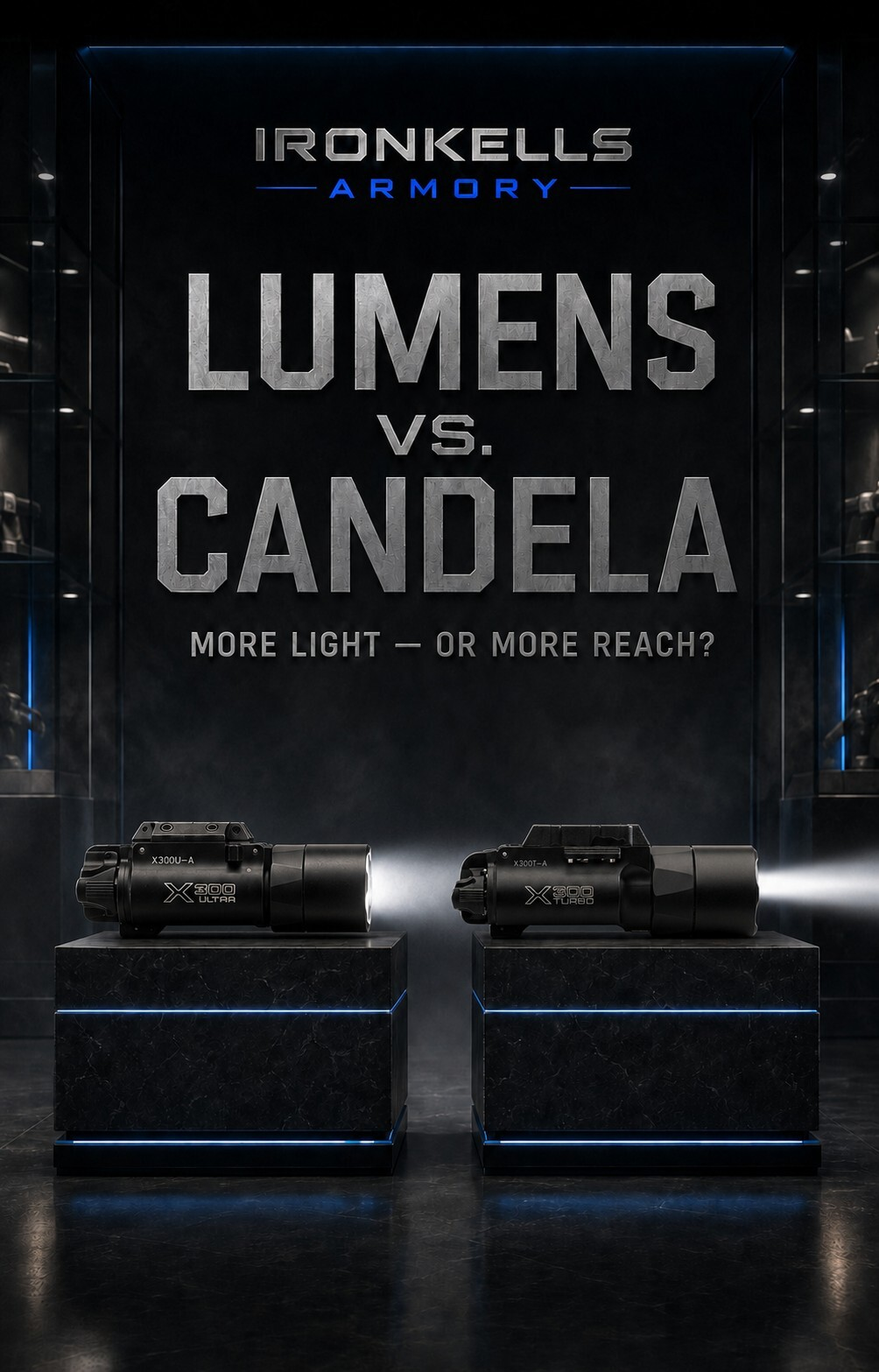
Lumens vs. Candela: More Light — or More Reach?
A practical IronKells Armory guide to flashlight and weapon-light output: what lumens measure, what candela measures, why beam shape matters, and why the biggest number on the box is not automatically the best light.
IronKells Armory | Lighting Education | Weapon Lights | Forge Files
For years, flashlight marketing trained people to look for one number first: lumens. Bigger number. Brighter light. Better light. Simple.
It is also incomplete.
A 2,000-lumen light can throw a giant wall of light and still reach less distance than another light producing only 650 lumens. A 1,250-lumen rifle light can produce dramatically more beam intensity than another light rated at 2,000 lumens. That is not marketing trickery. That is physics.
The missing number is usually candela.
If you remember one thing from this guide, make it this: lumens tell you how much visible light a light produces. Candela tells you how intensely that light is concentrated in a particular direction. Neither number tells the whole story by itself.
“Lumens tell you how much light you have. Candela tells you what the light does with it.”
The Fast Summary
Lumens = total visible light output. Think volume. It tells you how much light is being produced overall. [S1-S2]
Candela = directional light intensity. Think concentration. Higher candela generally means a stronger hotspot and more potential reach. [S1-S2]
Lux = light arriving at a surface. Lux changes with distance.
Beam distance = standardized reach. ANSI/PLATO FL 1 beam distance is based on the point where illumination falls to 0.25 lux. That is a standardized measurement — not a guarantee that you can clearly identify fine detail at that distance. [S2]
Lumens, Candela, Lux, and Beam Distance
| Measurement | Measures | Tells You | Does Not Tell You Alone |
|---|---|---|---|
| Lumens | Total luminous flux | How much visible light is emitted overall | Beam shape or reach |
| Candela | Luminous intensity in a direction | How concentrated the beam is | Total light output or spill |
| Lux | Illuminance on a surface | How much light reaches an area | Total output of the flashlight |
| Beam Distance | Distance to 0.25 lux under FL 1 | Standardized comparison of reach | Guaranteed identification distance |
What Lumens Actually Tell You
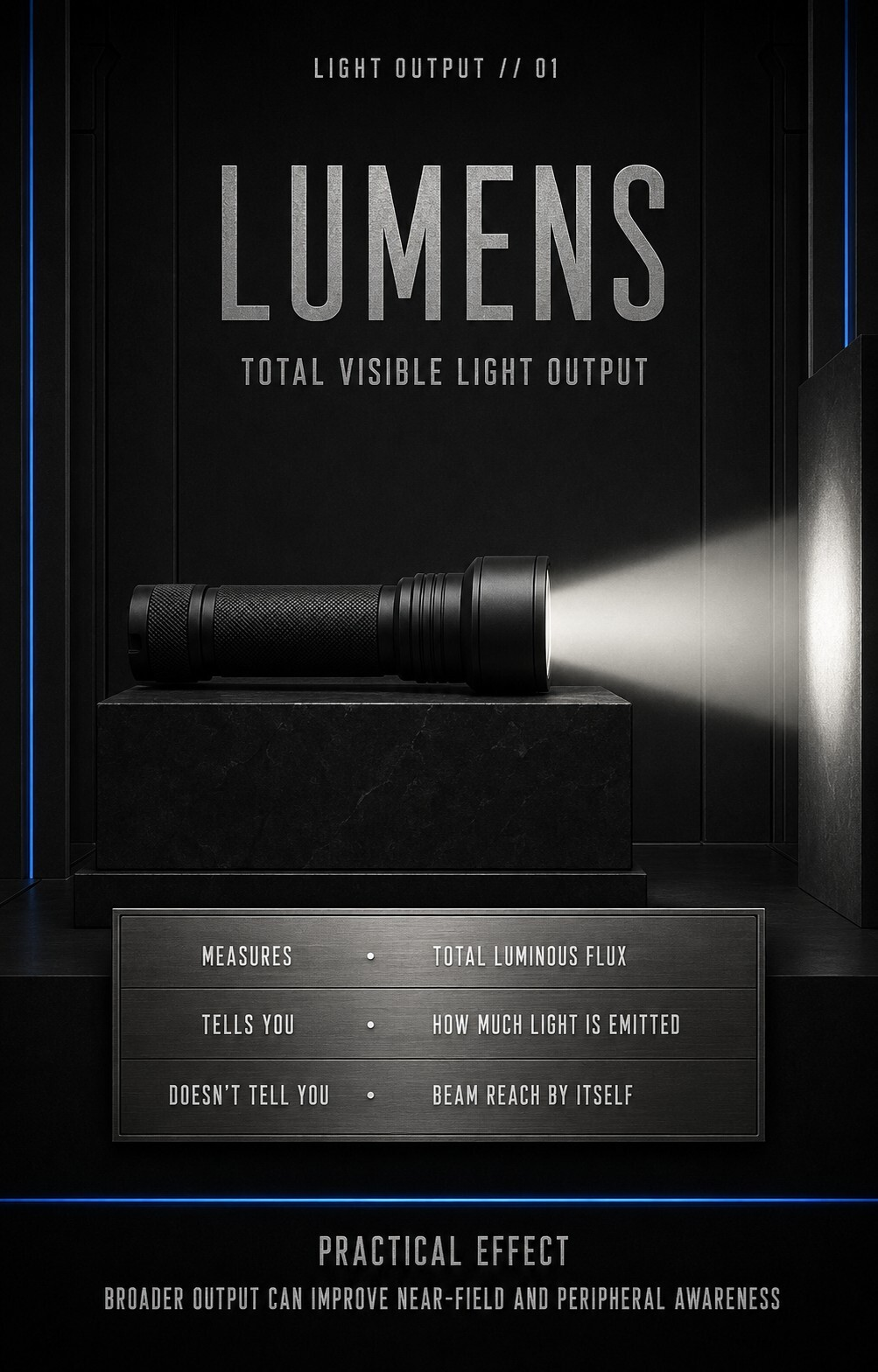
A lumen is a measurement of luminous flux — the total amount of visible light being produced. [S1]
Think about filling a five-gallon bucket with water. Lumens tell you how much water is in the bucket. They do not tell you whether you pour it gently across the floor or fire it through a pressure washer.
That is why a high-lumen light can be fantastic at lighting up a room, garage, yard, work area, or nearby surroundings while having relatively modest long-range performance.
The output is real. It is just being distributed over a wider area.
What Candela Actually Tell You
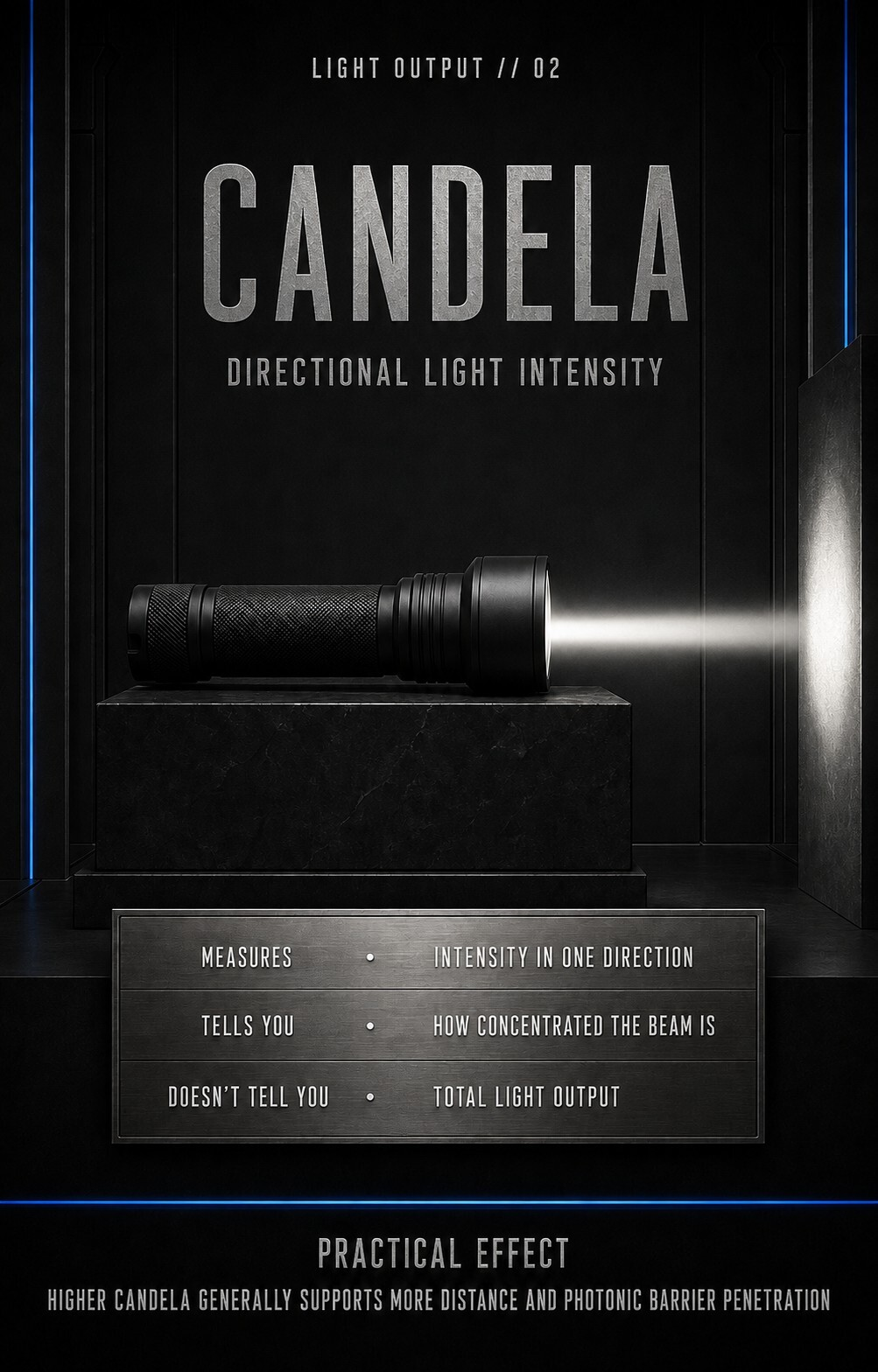
Candela measures luminous intensity in a particular direction. On a flashlight, peak candela normally describes the strongest portion of the beam near its center axis. [S1-S2]
Using the same bucket analogy, candela tells us something closer to the pressure and concentration of the stream.
Put more of the available light into a smaller angular area and peak candela rises. Spread the same light over a wider area and peak candela falls.
Higher candela generally gives you a stronger hotspot and more potential distance, but that does not automatically make it the better light. A tight beam can give up peripheral illumination and near-field coverage.
Beam Anatomy: Hotspot, Corona, and Spill
A flashlight beam is more than a white circle on a wall.
- Hotspot: the brightest central section of the beam. Peak candela is generally measured here.
- Corona: the transition zone around the hotspot.
- Spill: the wider, lower-intensity light around the hotspot. Spill helps illuminate nearby surroundings and peripheral areas.
Two lights can produce the exact same number of lumens and look completely different because the reflector, lens, LED, and optic determine where those lumens go.
The Comparison That Makes It Click
These examples show why buying a light by lumens alone makes about as much sense as buying a truck by horsepower without asking what the truck weighs, how it is geared, or what you need it to pull.
| Light | Lumens | Peak Candela | Published Reach | What It Shows |
|---|---|---|---|---|
| SureFire X300U-A Ultra | 1,000 | 11,300 | 213 m | Broad high-output handgun-light beam with substantially less concentration than the Turbo. [S3] |
| SureFire X300T-A Turbo | 650 | 66,000 | 514 m | Fewer lumens than the Ultra, but dramatically more concentrated intensity and reach. [S4] |
| Streamlight PolyTac 1X | 500 | 18,000 | 268 m | A clean example of why 500 lumens does not automatically mean weak throw. Rating shown with SL-B9 battery. [S5] |
| Streamlight ProTac 2.0 Rail Mount | 2,000 | 17,700 | 266 m | Huge total output with a comparatively broad beam profile. [S6] |
| Streamlight ProTac 2.0 Rail Mount HP | 2,000 | 85,000 | 583 m | Same 2,000 lumens as the standard version, but nearly 4.8 times the peak candela. [S7] |
| Cloud Defensive REIN 3.0 | 1,250 | 100,000 | 300+ yd identification claim | 750 fewer lumens than the 2,000-lumen Streamlights, but the highest candela in this group. [S8] |
Three Comparisons That Kill the Myth
X300 Ultra vs. X300 Turbo: The Ultra produces 1,000 lumens while the Turbo produces only 650. If you looked at lumens alone, you might assume the Ultra reaches farther. It does not. The Turbo produces 66,000 candela versus 11,300 candela — roughly 5.8 times the peak intensity. SureFire lists 514 meters of beam distance for the Turbo versus 213 meters for the Ultra. [S3-S4]
ProTac 2.0 Rail Mount vs. ProTac 2.0 Rail Mount HP: This is probably the cleanest comparison in the entire article because both lights are rated at exactly 2,000 lumens. The standard version produces 17,700 candela. The HP produces 85,000. Same total lumen rating. Wildly different beam intensity. Published reach increases from 266 meters to 583 meters. [S6-S7]
REIN 3.0 vs. the 2,000-lumen Streamlights: Cloud's REIN 3.0 is rated at 1,250 lumens and 100,000 candela. That means it produces 750 fewer lumens than either ProTac 2.0 model yet still produces more peak candela than either one. [S8]
Candela Per Lumen: A Useful Comparison Tool
One rough way to visualize beam concentration is to divide peak candela by lumens.
Important: Candela-per-lumen is not an ANSI rating, not an official performance metric, and definitely not a quality score. It is simply a useful way to compare how concentrated the published output is.
| Light | Approx. Candela Per Lumen |
|---|---|
| ProTac 2.0 Rail Mount | 8.9 |
| X300U-A | 11.3 |
| PolyTac 1X | 36.0 |
| ProTac 2.0 Rail Mount HP | 42.5 |
| REIN 3.0 | 80.0 |
| X300T-A | 101.5 |
Lux, Distance, and Why Light Falls Off So Fast
Candela becomes especially useful because it connects directly to how much light reaches a surface.
In the simplest far-field calculation:
Lux = Candela ÷ Distance²
Distance is measured in meters.
The square is the ugly part. Double the distance and the illuminance falls to one quarter. Triple the distance and it falls to one ninth.
That is why distance absolutely chews through light intensity and why candela becomes increasingly important as the target gets farther away.
Beam Distance Is Not Identification Distance
This distinction matters.
ANSI/PLATO FL 1 beam distance is based on the point where the beam reaches 0.25 lux. [S2]
That gives the industry a consistent comparison method, but 0.25 lux is not blazing illumination. A company publishing a 500-meter beam distance is not promising that you will clearly read a license plate, identify a person's face, or distinguish fine detail at 500 meters.
Real-world identification depends on the target, atmosphere, background, contrast, your eyesight, optic magnification, beam pattern, and environmental lighting.
Photonic Barriers: Useful Concept, Overused Buzzword
You will hear the phrase photonic barrier thrown around constantly in weapon-light conversations.
In practical terms, it usually means something that competes with or interferes with your illumination: headlights, streetlights, porch lights, illuminated windows, tint, smoke, dust, fog, or similar conditions.
Higher candela can help maintain useful intensity against competing ambient light because more light is concentrated on the area you are trying to see.
But do not turn the phrase into wizardry. Smoke, fog, dust, rain, glass, and reflective surfaces can also scatter light directly back toward you. More candela does not repeal physics.
Beam placement, angle, atmosphere, target reflectivity, color temperature, spill, and your own eyes still matter.
“The question is not which number is bigger. The question is where the light needs to go.”
Which Beam Is Better for Which Job?
There is no universal perfect lumen-to-candela ratio. The right answer depends on the job.
- Close-range general-purpose illumination: broader spill can help you see more of the immediate surroundings.
- Longer-distance outdoor illumination: higher candela becomes increasingly valuable because distance rapidly reduces lux on target.
- Handgun-mounted lights: size, controls, holster compatibility, spill, hotspot, candela, and overall output all matter.
- Long-gun lights: larger heads and more rail space make it easier to chase higher output and higher candela at the same time.
- Handheld / EDC lights: battery flexibility, runtime, pocket size, low modes, and useful spill can matter more than winning a spec-sheet contest.
Runtime, Heat, and the Peak-Output Trap
Maximum output numbers are only part of the story.
High-performance LEDs generate heat. Batteries sag under heavy load. Drivers regulate output. Some lights maintain output aggressively while others step down as the light heats up or battery voltage falls.
That means a giant headline number does not necessarily describe what the light produces throughout its entire advertised runtime.
ANSI/PLATO FL 1 provides standardized methods for output, runtime, peak beam intensity, beam distance, water resistance, and other portable-light performance claims. The revised FL 1-2025 standard also added standardized treatment for short-duration turbo or boost brightness claims. [S9]
Translation: look at the whole spec sheet, not the biggest number printed in 36-point font.
Common Lumens vs. Candela Myths
- “More lumens means more throw.” False. Lumens are total output. Beam shape determines how concentrated that output becomes.
- “Candela is beam distance.” Not exactly. Candela is luminous intensity. Standardized beam distance is calculated from intensity at a defined illumination threshold.
- “More candela is always better.” False. An extremely tight beam can sacrifice useful spill and near-field awareness.
- “A 500-lumen light is weak.” Not necessarily. The PolyTac 1X produces 18,000 candela and a listed 268-meter beam when using its SL-B9 battery. [S5]
- “A 2,000-lumen light must out-throw a 1,250-lumen light.” Wrong. The standard 2,000-lumen ProTac Rail Mount produces 17,700 candela while the 1,250-lumen REIN produces 100,000 candela. [S6, S8]
- “Published beam distance is practical identification distance.” No. It is a standardized comparison measurement.
The IronKells Light-Buying Checklist
When comparing flashlights or weapon lights, stop shopping by one number. Look at the whole tool.
- Lumens: total visible output.
- Peak candela: beam intensity.
- Beam pattern: hotspot size, corona, spill, and beam artifacts.
- Beam distance: useful for standardized comparison, but not the same as practical identification distance.
- Runtime: and whether the output is regulated or steps down significantly.
- Battery system: rechargeable, disposable, proprietary, or multi-fuel.
- Controls: momentary, constant-on, pressure switch, programming, and simplicity.
- Size and weight: especially on pistols and compact rifles.
- Mount or holster compatibility: because an incredible light that does not fit your setup is an expensive paperweight.
- Durability and water resistance: because spec-sheet horsepower means nothing when the light quits.
Plain English Version
If someone asks whether they need more lumens or more candela, the first question should be:
What are you trying to see, and how far away is it?
Want a broad wash of light nearby? Lumens and spill matter heavily.
Want a stronger center beam that holds intensity farther away? Candela becomes more important.
Want a good general-purpose light? You usually want enough of both, shaped into a clean beam with useful controls, acceptable runtime, and a form factor that actually works on the platform.
That is why the X300 Ultra is not automatically “better” because it has more lumens than the Turbo. The Turbo is not automatically “better” because it has more candela. They are designed around different beam priorities.
The same lesson is even clearer with the Streamlight ProTac 2.0 Rail Mount and Rail Mount HP: both produce 2,000 lumens, yet one produces 17,700 candela and the other 85,000.
Same total output. Different destination.
Bottom Line
Lumens are not fake. Candela is not king in every situation. They answer different questions.
Lumens tell you the total amount of visible light.
Candela tells you how intensely that light is concentrated.
Beam pattern tells you how those two numbers are actually delivered.
The best light is not the one with the biggest number. It is the one with the right beam for the job.
Buy the Beam — Not the Marketing Number
Compare the complete light: output, candela, beam shape, runtime, controls, durability, mounting, and the distance you actually need it to work.
Shop IronKells Armory Read The Forge Files Contact the ShopSource List / Receipts
Definitions and product specifications were checked against standards information and current manufacturer pages. Manufacturers can revise products and ratings, so always verify the latest specifications before purchase.
| ID | Source | Link |
|---|---|---|
| S1 | NIST — Candela and photometric measurement | Source link |
| S2 | Streamlight — ANSI/PLATO FL 1 Information | Source link |
| S3 | SureFire X300U-A Ultra | Source link |
| S4 | SureFire X300T Turbo | Source link |
| S5 | Streamlight PolyTac 1X | Source link |
| S6 | Streamlight ProTac 2.0 Rail Mount | Source link |
| S7 | Streamlight ProTac 2.0 Rail Mount HP | Source link |
| S8 | Cloud Defensive REIN 3.0 | Source link |
| S9 | PLATO — Revised ANSI/PLATO FL 1-2025 Standard | Source link |