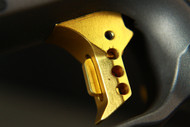
Glock Trigger Upgrade Guide
Posted by Your Glock That Wants A Trigger Upgrade on Sep 28th 2026
Glock Trigger Upgrade Guide
Connectors, striker springs, trigger shoes, safety plungers, carry setups, competition setups, Gen3/4/5 differences, light-strike problems, reset problems, and what actually changes when you start tuning a Glock trigger.
IronKells Armory | Glock | Triggers & Controls
The Glock trigger is reliable as hell.
It also leaves plenty of room for improvement.
Long take-up, stacking, a mushy wall, over-travel and a plastic trigger shoe don't bother everybody. But once you've shot a properly tuned Glock trigger, it's hard not to notice what can be cleaned up.
We've run everything from nearly stock carry triggers to stupid-light competition setups with tuned connectors, light striker springs, reduced plunger springs, polished internals, Timneys, Johnny Glocks, Ghost connectors and enough combinations to learn that pull weight alone doesn't tell you whether a trigger is good.
A good Glock trigger is about feel, consistency, reset, reliability and the job the gun is supposed to do.
“A lighter trigger isn't automatically a better trigger. A better trigger does exactly what you want, every damn time.”
The Fast Summary
The connector is one of the biggest bang-for-the-buck changes. You can noticeably change wall, pull weight and break without replacing the whole trigger.
The trigger shoe changes feel more than people think. Flat vs. curved, leverage, pre-travel and finger placement can make a trigger feel completely different without cutting pull weight much.
Reduced striker springs can lighten the pull. They can also start giving you light strikes if you go too far or pair them with the wrong striker/ammunition.
The safety-plunger spring is a cheap improvement. Reducing the resistance at that contact point can clean up the wall without completely changing the trigger system.
Carry and competition are different jobs. The trigger that feels amazing on a G34 race gun may be a dumb choice on a pistol you expect to live dirty in a holster.
Gen5 is not Gen3/4 internally. The tuning concepts overlap, but several actual parts and spring systems do not.
What Actually Changes Glock Trigger Feel
| Part | What It Changes |
|---|---|
| Trigger Shoe | Finger position, leverage, comfort, perceived take-up and travel. |
| Trigger Bar | Engagement geometry, smoothness, travel and reset characteristics. |
| Connector | Wall, break weight, trigger-bar release behavior and sometimes over-travel/reset feel. |
| Striker Spring | Trigger weight and primer-strike energy. |
| Trigger Return Spring | Reset force and, on Gen1–4-style systems, perceived pull weight. |
| Safety Plunger + Spring | The little bump or stacking sensation as the trigger bar lifts the firing-pin safety. |
| Surface Finish | Friction and smoothness between interacting metal parts. |
1. The Connector — Still One of the Best Cheap Upgrades
If somebody wants to improve a Glock trigger without rebuilding the whole damn thing, the connector is usually one of the first places we look.
Changing connector geometry can affect:
- Break weight
- How hard the wall feels
- How smoothly the trigger bar rolls through the break
- Over-travel on fitted connector designs
- Reset feel
We've always liked Ghost connectors because they give you several different personalities instead of one generic “lighter connector.”
Examples:
- Ghost Edge: drop-in, lighter/smoother feel, removes a lot of the stacking sensation.
- Ghost Angel 3.0: smoother rolling-style pull with much less wall/stacking.
- Ghost Rocket / Pro / EVO-style fitted connectors: designed to reduce over-travel and shorten reset when correctly fitted.
- OEM Minus Connector: simple factory option when you want a lighter break without completely changing the system.
Our old rule still stands:
If you only want to change one inexpensive internal part, the connector gives you a hell of a lot for the money.
Quick correction from the old Forge File: Glock's DOT connector and Minus connector are not the same connector. Gen5 pistols commonly use DOT connectors, but don't use “DOT” and “Minus” interchangeably when ordering or tuning parts.
2. Striker Springs: Where Lighter Pull Meets Primer Ignition
The striker spring is doing real work.
Lighter spring = less resistance during the trigger press.
But that same spring also has to hit the primer hard enough to light the round.
| Spring Range | How We Look at It |
|---|---|
| 6 lb | Extra ignition margin. Useful when reliability matters more than shaving ounces off pull weight. |
| Factory / roughly 5–5.5 lb territory | Broad reliability window and where we'd rather stay on a general-purpose gun unless we have a reason to change it. |
| 4.5 lb | Useful middle ground on tuned guns. Test your actual ammo. |
| 4 lb | Competition territory for us. Can run extremely well with the right striker and ammo. |
| 3.5 lb and below | Race-gun stuff. Now primer hardness, striker mass and maintenance become a much bigger deal. |
We've run tuned competition setups with light striker springs for very high round counts without ignition trouble.
That does not mean every 4 lb spring will ignite every primer in every pistol.
Test the ammo you actually use.
3. The Striker Itself Matters Too
A factory Glock striker is durable and gives you a lot of ignition margin.
Tuned setups may use:
- Polished OEM striker
- Lightened steel striker
- Skeletonized striker
- Aftermarket extended-tip designs
A lighter striker can reduce inertia requirements and make a light spring setup easier to tune.
But we don't jump straight to the lightest possible striker just because it exists.
Striker mass, striker spring and primer hardness all have to work together.
4. Safety Plunger & Spring — Cheap Upgrade, Noticeable Difference
The trigger bar has to lift the firing-pin safety plunger as the trigger moves rearward.
That's one of the friction points you can actually feel during the press.
A smoother plunger or reduced-power plunger spring can reduce that stacking sensation without completely changing the trigger system.
We've had good luck with:
- Polished OEM plungers
- NP3-coated plungers
- Apex-style enhanced plungers
- Reduced-power plunger springs
For the money, the plunger spring is still one of our favorite little trigger-feel changes.
5. Trigger Return Springs: Gen3/4 vs. Gen5 Matters
On Gen1–4-style trigger systems, the traditional trigger spring helps pull the trigger bar rearward during the press and helps drive reset.
That's why an extra-power 6 lb trigger spring can actually make the trigger press feel slightly lighter while also giving a strong reset.
We've used that combination plenty.
Gen5 changed the mechanism.
It uses a different compression-style trigger spring arrangement in the housing, so you don't tune a Gen5 exactly the same way you tune a Gen3.
Same goal. Different hardware.
Gen3 / Gen4 / Gen5 Trigger Differences
Gen3 and Gen4 have a lot of trigger overlap.
Gen5 changed enough that we treat it as its own trigger family.
Gen5 differences include:
- Different trigger bar
- Different trigger mechanism housing
- Different trigger spring design
- Different firing-pin safety geometry
- Ambidextrous slide-stop interaction
- Different striker / firing-pin details
This is why a manufacturer can sell one complete trigger system across several generations while the individual OEM parts inside those guns remain different.
Don't confuse kit compatibility with identical internals.
6. Trigger Shoes — You Don't Have to Chase a 2 lb Pull to Improve the Gun
Sometimes all somebody hates is the factory plastic shoe.
A good flat-face or improved curved shoe can:
- Give more consistent finger placement
- Change leverage
- Reduce perceived travel
- Improve comfort
- Give a cleaner-feeling press without dramatically lowering pull weight
That's why products like Overwatch TAC/DAT, Apex, ZEV and other quality shoes can make a Glock feel much better even when the pull gauge doesn't move much.
Feel matters.
Trigger Systems We Actually Pay Attention To
Glock Performance Trigger
This is Glock's own answer to people wanting a better trigger without immediately jumping into a pile of aftermarket geometry.
Current listed compatibility includes several Gen4 and Gen5 standard-frame pistols including G17, G19, G26, G34, G19X, G45 and G47.
Glock also supplies a Gen5 slide cover plate for Gen4 installations because the supporting parts are not identical.
We've found GPT-equipped guns noticeably cleaner and crisper than the traditional stock Glock trigger.
It's a strong option when you want an OEM-designed performance system without going full race-gun.
Johnny Glocks Evolution X
Johnny Glocks has always been one of the more interesting options because the triggers are built around feel and intended use instead of just chasing the lowest number on a trigger gauge.
The Combat setup gives you a more defined wall, crisp break and aggressive reset.
The Competition setup is built around a faster, lighter application.
The Evolution X also keeps a lot of OEM Glock architecture, which we like on hard-use builds.
Timney Alpha Competition
The Timney is different from a normal Glock trigger job.
Instead of the traditional cruciform doing all the striker-release work, the Alpha uses its own sear housing.
That's why Timneys can get down into very light competition pull weights while still keeping the factory striker spring.
Timney sells separate Gen3/4 and Gen5 versions.
We've liked them a lot in competition builds.
They also have more going on inside the housing than a stock Glock trigger, so we treat them more like performance equipment and keep them clean.
Overwatch Precision TAC / DAT / PolyDAT
Overwatch is a good example of improving geometry and shoe feel without having to turn the pistol into a race gun.
Their triggers reduce pre-travel and change leverage while keeping a more traditional Glock-style internal system.
One thing we respect: Overwatch openly recommends OEM connectors with its triggers because mixing aftermarket connector dimensions adds tolerance stacking.
We've mixed parts successfully plenty of times — but their point is valid.
Apex Action Enhancement
Apex has always been a solid middle-ground trigger.
Cleaner take-up, shorter travel, improved shoe and a more refined break without necessarily chasing competition-only pull weights.
Apex also engineered a Gen5-specific system around the Gen5 ambidextrous slide-stop and changed internals instead of pretending the older trigger was universal.
ZEV Fulcrum / PRO
ZEV has been in the Glock trigger game forever.
The PRO is preset.
The Fulcrum is the adjustable version with pre-travel and over-travel adjustment.
Adjustability is great until somebody adjusts the damn thing too far.
Travel adjustment should never come at the expense of proper safety engagement or reliable reset.
Carry vs. Competition: Different Jobs
| Goal | Carry / General Purpose | Competition |
|---|---|---|
| Pull | Clean and predictable; roughly 3.5–5 lb depending on setup and shooter preference | Often 2–3.5 lb |
| Pre-travel | Keep enough for positive trigger-safety engagement and predictable staging | Can be shorter, but still must preserve safe operation |
| Striker Spring | Factory or near-factory is our preference | 4–4.5 lb common in tuned setups |
| Reset | Positive and tactile | Short and aggressive |
| Ammo Tolerance | Broad | Can be tuned around specific match ammo |
| Maintenance | Should tolerate normal hard use | More frequent inspection is normal |
A Carry-Oriented Setup We Like
Our goal isn't the lightest number possible.
We want:
- Good trigger shoe
- Clean connector
- Factory or near-factory striker spring
- Smooth plunger interaction
- Positive reset
- All safety functions intact
- Broad primer and ammunition reliability
One of our old G19 Gen5-style recipes looked roughly like:
- Ghost Angel / Edge-style connector or quality OEM connector
- Factory or ~5 lb striker spring
- Proper Gen5 trigger-return system
- Reduced-power plunger spring
- Polished or coated plunger
- Quality flat trigger shoe
- Approximately 3.5–4.5 lb finished pull depending on the exact combination
We care more about the clean press and reliable reset than whether the gauge says 3.8 or 4.2.
Our G34 Competition Direction
Now we can get stupid.
Our G34 Gen5 competition-style setups have used combinations such as:
- Ghost Angel-style connector
- 4 lb striker spring
- Reduced-power plunger spring
- Polished / coated plunger
- Johnny Glocks striker or tuned striker
- Timney Alpha or Johnny Glocks competition trigger
- Polished contact surfaces
- Tunable recoil system
- 13 lb recoil spring
- Optic, magwell and extended magazines
We've had G34 competition setups down in roughly the 2.2–2.8 lb neighborhood with extremely short resets.
We've also run very large round counts through light-spring setups without ignition issues when the striker, spring and ammunition were matched correctly.
That's a competition setup. We're not pretending it's the same thing as the pistol you throw in a holster every morning.
Light Strikes: Don't Blame the Ammo Before Looking at the Trigger Setup
If you changed the striker spring and suddenly start getting click instead of bang, the timing is suspicious as hell.
Look at:
- Striker spring weight
- Striker mass
- Primer type
- Striker-channel contamination
- Striker damage or drag
- Ammunition consistency
We've had tuned setups run Federal HST and other ammunition for huge round counts without light-strike trouble.
That does not mean every light striker spring will do the same thing in every pistol.
Test your actual setup.
Reset Problems
A trigger that feels amazing but doesn't reset every time is garbage.
If reset problems start immediately after trigger work, look at:
- Trigger return spring / return mechanism
- Connector fit
- Too much pre-travel reduction
- Too little over-travel
- Trigger bar geometry
- Debris inside an aftermarket sear system
Timney's Alpha is a good example of why the design matters: it uses a separate sear housing, and debris inside that mechanism can create problems that don't look exactly like traditional Glock trigger failures.
The faster and tighter the trigger gets, the less bullshit tolerance you usually have.
Polishing vs. Changing Geometry
We're fine with smoothing rough contact surfaces.
We are not talking about blindly grinding safety surfaces until the trigger feels cool.
There's a difference between:
- Smoothing an existing surface
- Changing the angle or amount of engagement
The second one changes the actual safety geometry. That's not where we guess.
Drop-In vs. Fitted Connectors
Not every Ghost connector is the same kind of install.
Ghost divides its lineup between drop-in connectors and fitted Trigger Control Connector designs such as Rocket / Pro / EVO-style models.
The fitted designs use an over-travel control tab that has to be correctly matched to the pistol.
If you're using a fitted connector, treat it like fitted trigger work instead of pretending it's another random drop-in part.
No Trigger Leaves the Bench Just Because It Feels Good
After trigger work, the trigger has to prove more than a nice dry-fire break.
We verify:
- Trigger safety blocks rearward trigger movement unless deliberately depressed
- Firing-pin safety remains functional
- Drop-safety engagement remains correct
- Trigger resets positively every time
- Trigger does not release the striker with the slide out of battery
- No dragging, binding or intermittent reset
- Live-fire ignition is reliable with the ammunition intended for the gun
We don't do improvised “drop tests” by banging loaded or assembled guns around the shop.
Safety engagement gets inspected properly. Then the gun gets tested.
How We Prove a Trigger Setup
- Verify the safety functions before live fire.
- Dry-cycle enough to make sure reset is consistent.
- Start live testing with ammunition we already trust.
- Test slow fire and fast strings.
- Test multiple magazines.
- If using a reduced striker spring, test several ammunition types.
- Watch for light strikes, reset failures, doubles or any abnormal behavior.
- Get enough rounds through it to know it still works after carbon and heat show up.
A trigger isn't proven because it felt badass during ten dry fires on the couch.
Quick Setup Cheat Sheet
| Goal | Good Starting Direction |
|---|---|
| Stock gun feels gritty | Clean/polished contact surfaces, quality connector, plunger spring/plunger |
| Want better feel without much lighter pull | Trigger shoe + mostly OEM internals |
| Carry-oriented upgrade | Quality shoe / Combat-style kit, OEM or near-OEM striker spring, clean connector, positive reset |
| Budget performance | Connector + plunger spring + polished contact surfaces |
| Competition | Timney / Johnny Glocks / tuned Ghost-ZEV style setup, 4–4.5 lb striker spring if needed, short aggressive reset |
| Light strikes after trigger work | Striker spring, striker mass, striker-channel cleanliness, ammo/primer sensitivity |
| Trigger won't reset | Return spring/system, connector fit, over-adjustment, trigger bar geometry, debris |
Common Glock Trigger Questions
What's the easiest Glock trigger upgrade?
For the money, a quality connector is hard to beat. A better trigger shoe is another good choice if the main complaint is feel rather than weight.
Do I need a complete trigger kit?
No. Plenty of excellent Glock triggers are still mostly OEM parts with a connector, shoe, polished contact surfaces and a couple carefully chosen springs.
Is a 3 lb Glock trigger automatically unsafe?
Pull weight alone doesn't answer that question. Safety engagement, trigger travel, reset, striker engagement, installation quality and intended use all matter. But a 2–3 lb race trigger has a much smaller margin for sloppy handling than a normal general-purpose setup.
Can a lighter striker spring cause light strikes?
Absolutely. We've also run light striker springs reliably for huge round counts. Both things can be true. The complete striker/spring/ammo combination decides the result.
Is Timney better than a normal Glock trigger kit?
It's different. The Alpha changes the release architecture by adding its own sear system, which is why it can get very light without relying as heavily on reduced striker springs.
Does Gen5 use the same trigger springs as Gen3/4?
No. Gen5 changed the trigger return spring arrangement and several other trigger-system parts.
Should I remove all the pre-travel?
No. We want a better trigger, not a trigger adjusted so aggressively that safety engagement or reset becomes questionable.
Related Forge Files
Glock Compatibility Guide
Gen3, Gen4, Gen5 and Gen6 parts compatibility.
Glock Failure to Return to Battery
Trigger-bar drag, connector problems and mechanical resistance that can affect slide closure.
Glock Recoil Spring Tuning
Useful when trigger/striker tuning overlaps with ultra-light competition recoil systems.
Glock Light Primer Strikes
Striker springs, striker mass, primer sensitivity, contamination and ignition diagnosis.
Bottom Line
You don't need a $300 trigger to make a Glock trigger better.
You also don't need to be scared of a properly tuned aftermarket setup.
Connector changes matter.
Spring balance matters.
Trigger geometry matters.
Primer ignition matters.
Reset matters.
The intended job matters most.
Build the trigger for the gun you're actually using — then make the setup prove itself.
Better Break. Better Reset. Same Damn Reliability.
Improve what matters. Don't chase a trigger-gauge number just because it's smaller.
Glock Forge Files Shop GlockSource List / Receipts
This guide combines the original IronKells trigger material, our own tuned-Glock experience, other shooters' real-world experience, and current trigger-manufacturer information.
| ID | Source | Used For |
|---|---|---|
| S1 | Original IronKells Trigger Upgrade Breakdown | Connector tuning, spring weights, carry/competition builds, trigger components and original shop experience |
| S2 | GLOCK Performance Trigger Compatibility | Current Gen4/Gen5 GPT model compatibility and Gen5 backplate requirement |
| S3 | Timney Alpha Competition | Gen3/4 vs Gen5 architecture, sear system, pull weights and competition experience |
| S4 | Ghost Angel 3.0 | Current Angel 3.0 Gen1–5 system and connector feel |
| S5 | Overwatch Precision | TAC/DAT geometry and OEM-connector recommendation |
| S6 | Apex Tactical Gen5 Trigger | Gen5-specific trigger design and reduced travel/reset |
| S7 | Johnny Glocks FAQ | Evolution X Combat vs Competition intent, OEM-parts architecture and current recommendations |
| S8 | ZEV Trigger / Internal FAQ | Fulcrum vs PRO trigger differences and Gen5 component information |
| S9 | IronKells Testing / Shooter Experience | Light striker springs, G19 carry-style setups, G34 competition setups, pull weights, reliability and long-term tuned-trigger use |
IRONKELLS ARMORY | FORGE FILES
Receipts Over Rumors.
Tune the feel. Keep the safety. Make the trigger prove itself.