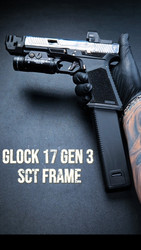
Glock Compensator Guide
Posted by The Glockster on Sep 28th 2026
Glock Compensator Guide: Ammo, Springs, Tuning & Reliability
Micro comps, big comps, 115 vs. 124 vs. 147gr, +P, recoil springs, slide timing, reliability, barrel fitment, sight tracking, and what we've actually seen happen when you start hanging compensators off Glocks.
IronKells Armory | Glock | Compensators | Recoil Systems
A properly set-up compensated Glock is fucking fun to shoot.
The gun stays flatter. The dot comes back faster. Follow-up shots feel easier. And when the comp, ammunition and recoil system actually agree with each other, the pistol can still run boringly reliable.
The problem is people install a comp, immediately start swapping springs, buy whatever ammo is cheapest that week, then blame the compensator when the whole setup turns into a malfunction drill.
We've run small comps, big comps, light springs, factory springs, hotter ammo, softer ammo, full-size guns, compact guns, heavy slides, light slides and enough combinations to know one thing:
There is no single compensated-Glock recipe.
“A comp doesn't make a gun unreliable. A bad combination of comp, ammo, spring and setup does.”
The Fast Summary
Micro comps are easiest to live with. They usually give up some maximum muzzle-rise reduction in exchange for easier reliability and less added length.
Bigger comps usually reward hotter ammo more. More useful muzzle gas gives the comp more to work with.
124gr is our favorite all-around starting point. We've had very good luck with full-power 124gr and 124gr +P in compensated Glocks.
115gr does not automatically suck. Plenty of modern micro and mid-size comps run quality 115gr on factory springs. Weak 115 is where things get more interesting.
147gr can run great. It carries plenty of recoil impulse, but lower-pressure heavy-bullet loads may not work the comp as aggressively as hotter 124gr loads.
Start with the factory recoil system. Change spring weight because the gun gives you a reason.
Tune around your actual ammo. A gun set up perfectly for soft range ammo may be completely different from one living on +P defensive ammunition.
What a Compensator Is Actually Doing
The bullet leaves the barrel with a hell of a lot of high-pressure gas behind it.
A compensator redirects some of that gas — usually upward and sometimes partly sideways — so the gas pushes against the comp and counters some of the muzzle's tendency to rise.
That can make the gun:
- Stay flatter
- Track the dot more predictably
- Recover faster between shots
- Feel softer or at least less muzzle-flippy
One correction to the way this sometimes gets explained:
A Glock is a recoil-operated locked-breech pistol. The comp isn't stealing gas from some gas system that operates the slide.
What it can do is change the recoil impulse and barrel/slide dynamics enough that a setup that had plenty of cycling margin before now has less.
Micro Comp vs. Big Comp
| Type | What We Like | Trade-Off |
|---|---|---|
| Micro / single-port | Compact, carry-friendly, usually easier to keep reliable, works with broad ammo range | Usually less total compensation than a large multi-port setup |
| Mid-size comp | Good middle ground between flatness and reliability | May start caring more about ammunition and spring weight |
| Large / multi-port | Maximum muzzle control, excellent competition potential | More length, blast, tuning sensitivity and ammunition dependence |
More comp isn't automatically better. The best comp is the amount of comp that fits the job.
Ammo Is Half the Comp Setup
Compensators like gas.
Generally, ammunition producing more useful muzzle pressure gives a compensator more gas to redirect.
That's one reason a hot 124gr load can make a comp feel dramatically different from weak 115gr range ammunition.
But don't turn that into a dumb rule that heavier bullet always equals better comp performance.
Bullet weight, velocity, powder burn rate, barrel length and pressure all affect what is happening at the muzzle.
The box saying 115, 124 or 147 tells you one part of the story.
115 vs. 124 vs. 147gr in a Comped Glock
| Ammo | What We've Seen | Where It Makes Sense |
|---|---|---|
| 115gr standard pressure | Quality full-power 115 often runs micro and mid-size comps just fine. Weak bulk ammo can expose marginal spring/comp setups. | Cheap training, micro comps, guns with broad reliability margin |
| 124gr standard pressure | Our favorite general starting point. Good balance of cycling impulse and gas for a lot of setups. | Training, general-purpose comped guns, tuning baseline |
| 124gr +P | Works comps hard and usually gives plenty of cycling margin. One of our favorite defensive-comp combinations. | Carry/duty-style setups after reliability testing |
| 135gr +P | Strong middle-weight option with plenty of impulse and useful gas. | Defensive / full-power comp setups |
| 147gr standard pressure | Can cycle extremely well because of total recoil impulse, often feels like a slower push. It may not drive the comp as aggressively as a hotter 124. | Shooters who like the heavier-bullet feel, suppressor crossover, some competition setups |
Power Factor Is Useful — But It Doesn't Tell You Everything
Competition shooters use power factor as a quick way to compare bullet weight and velocity:
Power Factor = Bullet Weight × Velocity ÷ 1000
A 124gr bullet at 1,200 fps is roughly PF 149.
A 147gr bullet at 1,000 fps is PF 147.
Those numbers look almost identical.
The two loads can still make a compensator feel different because PF does not tell you muzzle pressure, powder gas volume or burn characteristics.
On some of our larger compensated setups, ammo around the 140+ PF neighborhood has given us comfortable reliability margin.
That's a useful real-world reference — not a universal minimum.
Recoil Spring Tuning With a Comp
Our rule is simple:
Start with factory springing unless the gun gives you a reason not to.
If the gun runs:
Leave it alone and go shoot.
If the gun weakly ejects, short-strokes, stovepipes or doesn't consistently pick up the next round after the comp goes on, now spring weight matters.
Some real-world starting points we've used:
| Setup | Where We'd Start |
|---|---|
| Micro comp + full-power ammo | Factory recoil system |
| G19 single-port comp | Factory first; 15 lb if needed; 13 lb if the setup still wants less |
| G17/G34 single-port comp | Factory first; around 15 lb is a useful tuning step |
| Large / aggressive comp + soft ammo | 13–15 lb territory is common |
| Purpose-built race gun | May go below 13 lb, but now the entire spring system matters |
For the full spring discussion, see the Glock Recoil Spring Tuning Guide .
Why We Keep Talking About 13 lb
Because it isn't something we invented.
We've used it. Other shooters use it. And manufacturers of aggressive Glock comps openly talk about it.
Killer Innovations currently says they've seen compensated setups run anywhere from factory weight down to 11 lb, with a lot of shooters landing at 13 lb.
They specifically recommend a 13 lb spring on their G19 compensator setup.
That's useful data. It just doesn't mean every Glock with a chunk of aluminum on the muzzle needs a 13 lb spring.
Ultra-Light Springs: Now the Striker System Starts Mattering
Once you get way down in recoil spring weight, the striker spring becomes part of the conversation.
The recoil spring is trying to drive the slide forward while the striker system creates opposing resistance during the cycle.
With normal spring weights, who cares.
With an 11 or 12 lb recoil spring, you may suddenly care a lot.
We've run competition Glocks with lighter striker springs and light recoil springs successfully for very high round counts.
But once you start messing with striker spring weight, primer hardness and ignition reliability become another variable.
That's race-gun tuning. Don't accidentally turn your carry gun into one.
Carry Setup: Keep It Simple
For a carry-style Glock, we like a micro or efficient single-port comp.
Examples of the general style:
- Radian Afterburner + Ramjet
- PMM Micro / JTTC-style setups
- Herrington micro / compact comps
- Other quality single-port carry comps
What we want:
- Noticeably flatter shooting
- Factory or near-factory recoil system
- Broad ammo tolerance
- Reasonable added length
- No constant tuning bullshit
If a carry comp only works with one weird spring and one specific box of ammo while clean, that's not the direction we'd choose for that job.
General-Purpose / Nightstand / Belt Gun
When concealment isn't the main concern, we don't mind going a little bigger.
A G17 or G45 with a good mid-size comp, optic and weapon light can be an extremely easy gun to shoot fast.
Here we're willing to accept:
- More muzzle blast
- More added length
- A 15 lb spring if the gun genuinely prefers it
- A little more maintenance
What we still don't accept is unreliable.
Competition: Now We Can Get Weird
Competition changes the goal.
You're willing to trade some broad operating margin for:
- Flatter sight tracking
- Faster splits
- Specific ammunition
- Specific spring weights
- More aggressive compensators
We've run Glock competition setups with big comps, 13 lb recoil springs, lighter striker springs, tungsten guide rods, optics and extended magazines for tens of thousands of rounds.
Those guns can be stupid fast and stupid flat.
They're also not the same thing as a stock G19 with a micro comp — and we shouldn't pretend they are.
Comp Systems We Pay Attention To
Radian Afterburner + Ramjet
One of the cleanest carry-oriented systems because the barrel and comp are designed together and the comp uses a proprietary locking setup instead of a normal threaded-barrel arrangement.
We've liked this style because you get meaningful comp performance without turning the gun into a giant competition setup.
Radian also offers its COMPRESSOR guide rod for shooters who want 13, 15 and 18 lb tuning options.
PMM
PMM's shim-timed comps have been popular for a reason.
The comp is timed against the slide using shims and secured on the barrel rather than just being cranked on wherever the threads happen to stop.
We've always liked that kind of purpose-built barrel/comp relationship better than trying to make random parts line up by luck.
Herrington Arms
Herrington is a good example of why “115 won't run a comp” is too broad.
They currently say their comp designs have been run extensively on 115gr ammunition and OEM recoil springs.
That doesn't mean every box of weak 115 will run every giant comp.
It means modern comp design matters.
Killer Innovations
KI sits farther toward the tuning-heavy end.
We've run the Velocity comp on competition-style Glocks and it can make a gun ridiculously flat.
KI openly says compensated setups can require tuning and that they've seen spring weights from factory down to 11 lb, with 13 lb very common.
That lines up with what we've seen.
KKM
KKM has been around forever in the match-barrel and competition-Glock world.
Their barrel/comp systems are a different animal from grabbing a generic 1/2×28 threaded barrel and screwing on whatever fits.
KKM even uses dedicated compensator thread patterns on some systems because the barrel and comp are intended to work as a package.
Barrel and Thread Compatibility Matters
Don't buy a comp because the listing says “Glock” and assume you're done.
Check:
- Model
- Generation
- Thread pitch
- Thread length
- Shoulder geometry
- Guide-rod clearance
- Whether the comp indexes off the shoulder, shims, set screws or proprietary barrel features
We've seen suppressor-threaded barrels that technically accept a comp but don't place it in the right position relative to the slide.
“Threads on” and “fits correctly” are not the same thing.
Installation Problems Cause a Lot of “Comp Problems”
A compensator that isn't installed correctly can create an entire list of bullshit that gets blamed on ammo or spring weight.
Things we've seen:
- Comp backed off and started touching the slide
- Set screws loosened
- Wrong barrel thread length
- O-ring or thread protector left where it shouldn't be
- Comp not timed straight
- Guide rod hitting the comp
- Thread locker used like somebody was building a bridge
Follow the mounting system for the comp you're actually using.
PMM, Radian, KI, Herrington and KKM all secure and index their comps differently.
Compensators Get Filthy
You're blasting hot dirty gas directly into little chambers and ports.
Carbon buildup is part of the deal.
It can build around:
- Ports
- Blast baffles
- Locking rings
- Thread interfaces
- Set-screw systems
We've seen comps get carbon locked badly enough that removal becomes a project.
KI currently recommends periodic inspection and cleaning and specifically warns shooters to keep the locking mechanism clean.
Paint-marking mounting screws is also cheap insurance. If the line moves, something moved.
The Part Nobody Talks About Enough: Blast
A comp makes the gun louder and nastier around the muzzle.
Especially indoors.
Especially beside walls.
Especially under covered firing lines.
The more aggressively you redirect gas, the more noticeable that blast can become.
That's one more reason we don't automatically put the biggest possible comp on every pistol.
Don't Forget the Holster
Add a comp and you just changed the overall length of the gun.
Whether your existing holster still works depends on:
- Open or closed muzzle
- Comp width
- Comp length
- Weapon light
- Where the holster gets its retention
A G19 with some micro comps ends up around G17-ish overall slide length.
That doesn't automatically mean every G17 holster fits it. But it's a useful place to start looking.
How We Test a New Comp Setup
- Install the comp correctly and make sure nothing contacts the slide or guide rod.
- Start with the recoil setup we already know works.
- Run quality ammunition first.
- Watch ejection and slide lock.
- Use more than one magazine.
- Watch the dot or sights instead of only judging “felt recoil.”
- If it malfunctions, change one thing.
- Try a spring step only when the symptoms point toward cycling energy.
- Test the ammunition the gun is actually going to use.
- Get the gun dirty enough to make sure it doesn't only work fresh off the bench.
If it's a gun you're going to depend on, don't call it proven because it ran two magazines.
Comp Setup Troubleshooting
| What You See | What We Start Looking At |
|---|---|
| Weak ejection after comp install | Ammo power, spring weight, comp efficiency, friction |
| Stovepipes | Incomplete slide travel, ammo, recoil spring, extractor/ejector |
| Fails to pick up next round | Slide travel, magazine speed, recoil spring, ammunition |
| Stops short of battery | Spring too light, barrel fit, extractor drag, fouling, optic hardware |
| Runs hot ammo but not weak range ammo | Setup has limited cycling margin; decide which ammo you're tuning around |
| Comp keeps rotating / backing off | Installation, locking method, thread locker, timing hardware |
| Ran great clean, fails dirty | Not enough reliability margin, fouling, spring weight, tight fitment |
A Setup We've Actually Run
One of our G34 Gen5 compensated setups is a good example of why we're not interested in one universal spring rule.
With quality 124gr ammunition, a large comp and the factory-style recoil setup, we ran approximately 200 rounds in that test without a malfunction.
Ejection stayed roughly in the 4–5 foot neighborhood and the gun was completely functional.
Then we went to a 15 lb spring.
The gun was still reliable, but the follow-up shots felt faster and the sight return was better.
That's tuning. The factory spring wasn't “wrong.” We found a setup we liked better.
If We Were Starting a Comped Glock From Scratch
For a normal carry or general-purpose build:
Quality micro or single-port comp.
Quality barrel or matched barrel/comp system.
Factory recoil system first.
Good 124gr ammunition as the baseline.
Full-power 124gr or 124gr +P if we're trying to make the comp work harder.
Only change spring weight if the gun or our tuning goal gives us a reason.
That's where we'd start. Then we'd let the gun tell us the rest.
Common Glock Compensator Questions
Do compensators make Glocks unreliable?
Not automatically. We've run comped Glocks extremely reliably. The more aggressive the comp and the softer the ammunition, the more likely the overall setup may need tuning.
Will 115gr ammo run a compensator?
Often, yes. Quality 115gr runs plenty of modern micro and mid-size comps. Weak bulk ammunition is more likely to expose a marginal setup, especially with a large comp.
Is 124gr better for comps?
It's our favorite general starting point. Full-power 124 and 124 +P tend to provide a good combination of recoil impulse and useful gas for a lot of compensated Glocks.
Does 147gr work?
Absolutely. A 147gr load can cycle very well and many shooters like the recoil feel. It may not make the comp work as aggressively as a hotter, higher-pressure 124gr load.
Do I automatically need a lighter recoil spring?
No. Start with what already works. Plenty of modern comp systems are designed around factory recoil springing.
Why does my compensated Glock run defensive ammo but choke on cheap range ammo?
Because the hotter ammunition is giving the system more operating margin. Decide whether you're going to tune around the cheap ammo, use different ammo, or change the spring setup.
Can a comp make the gun louder?
Hell yes. You're redirecting muzzle gas. Expect more blast around the gun, especially indoors or beside walls.
Related Forge Files
Glock Recoil Spring Tuning
13, 15, 17, 18 and heavier spring setups, sight tracking, ammo and slide timing.
Glock Failure to Feed
What to check if the pistol starts choking after the comp goes on.
Glock Failure to Return to Battery
For slides that stop short of fully closing after tuning changes.
Glock Magazine Troubleshooting
Magazine spring speed, nose-dives and tuned guns outrunning marginal magazines.
Glock Compatibility Guide
Barrel, slide, generation and parts compatibility before building the setup.
Bottom Line
A compensator is not magic.
It is another part of the system.
More gas generally makes the comp work harder.
Bigger comps generally demand more attention to the setup.
Micro comps generally give you more reliability margin.
124gr is one hell of a good place to start.
Factory recoil springing should get the first chance.
Then shoot the damn gun and tune what it actually needs.
Shoot Flatter Without Making the Gun Stupid.
Pick the comp for the job. Feed it decent ammo. Tune only what needs tuning.
Glock Forge Files Recoil Spring GuideSource List / Receipts
This guide combines the original IronKells Compensators 101 material, our own compensated-Glock experience, shooter/build experience and current manufacturer tuning information.
| ID | Source | Used For |
|---|---|---|
| S1 | Original IronKells Compensators 101 | Ammo, PF, spring tuning, build types, parts experience and original real-world recommendations |
| S2 | Killer Innovations Compensator Tuning Guide | 11–factory spring range, common 13 lb setups, ammo interaction and striker/recoil-spring interaction |
| S3 | Killer Innovations FAQ | G19 13 lb recommendation, ammo quality, barrel/thread requirements and model-specific comp compatibility |
| S4 | Herrington Arms FAQ | 115gr / OEM-spring testing and self-timed threaded-comp installation |
| S5 | Radian Afterburner + Ramjet Instructions | Proprietary barrel/comp lockup, maintenance and carbon-lock considerations |
| S6 | KKM Precision FAQ | Dedicated compensator threads, barrel/comp relationship and fitment considerations |
| S7 | PMM JTTC Installation Instructions | Shim timing, comp alignment and barrel/comp installation system |
| S8 | IronKells Testing / Shooter Experience | G34 comp testing, 124gr ammo, factory vs. 15 lb spring behavior, sight tracking and long-term competition setup experience |
IRONKELLS ARMORY | FORGE FILES
Receipts Over Rumors.
Feed it. Tune it. Shoot it. Make the setup prove itself.