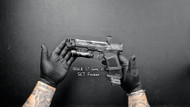
Glock Holster Fitment
Posted by Just Some Guy on Sep 28th 2026
Glock Holster Fitment
G17, G19, G19X, G26, G34, G43X, G45, G47 and G48 fitment — plus weapon lights, optics, threaded barrels, compensators, magwells, aftermarket frames, suppressor-height sights, and why “it's made for a Glock” doesn't tell you nearly enough.
Glock | Holsters & Carry Fitment | Forge Files
Holster shopping should be simple.
You've got a Glock 19. Buy a Glock 19 holster.
Then somebody adds an X300, Holosun, threaded barrel, comp, suppressor-height sights, magwell and aftermarket frame — and suddenly that “G19 holster” doesn't fit worth a shit.
Or it fits physically but the retention sucks.
Or a longer Glock fits because the muzzle is open.
Or the same gun won't fit because the new weapon light changed the entire retention area.
Holster fit is about the entire gun configuration, not just the model stamped on the slide.
“Fits in the holster and belongs in the holster are two different things.”
The Fast Summary
Start with the exact model and generation. A holster maker listing G17 Gen5 separately from Gen1–4 is doing it for a reason.
Weapon light usually matters a lot. A TLR-1 holster is not automatically a TLR-7 holster just because both lights are Streamlights.
Optic cuts are usually easy — until they're not. Optic location, optic width and sight height can all create clearance problems.
Open-bottom holsters are comp-friendly. Slide-width comps often pass through them. Closed-muzzle and muzzle-plug holsters can stop the gun before it seats.
Light-bearing retention isn't universal. Some designs retain the pistol independently of the light. Others need the exact weapon light installed to retain correctly.
Aftermarket Glock-pattern frames deserve their own fit check. SCT, Polymer80 and similar frames can change trigger-guard, dust-cover and rail dimensions enough to affect holsters.
Don't force it. A holster isn't supposed to flex around a setup it wasn't designed for and somehow become safe because you shoved harder.
What Actually Controls Holster Fit
| Part of the Setup | Why It Matters |
|---|---|
| Trigger Guard | Major retention area on many passive-retention holsters. |
| Slide Width & Shape | Controls how the upper body enters and tracks through the holster. |
| Slide Length | Matters on closed-muzzle holsters and holsters using muzzle plugs/stops. |
| Weapon Light | Can become the widest part of the setup and may become part of the retention system. |
| Optic | Needs enough clearance around the top/rear of the slide. |
| Comp / Threaded Barrel | Adds muzzle length and possibly width or height. |
| Sights | Tall sights need enough sight-channel clearance. |
| Frame / Dust Cover | Aftermarket frames can differ even when they're designed around Glock-pattern internals. |
1. Know the Glock Family First
| Family | Holster Reality |
|---|---|
| G17 / G34 | Same basic full-size frame family, but G34 has the longer slide. Open-muzzle designs may overlap; closed-muzzle designs often care about length. |
| G19 | Compact-length upper and grip. Huge holster support, but generation/light/accessory still matter. |
| G19X / G45 | G19-length upper with full-size grip. Many G19 holsters work because the holster doesn't care about grip length, but magwell/frame details can still matter. |
| G47 | Full-length slide over G45-style frame. Think full-size upper length when evaluating muzzle clearance. |
| G26 | Shorter upper and shorter frame. May fit some longer open-bottom designs but don't assume retention is identical. |
| G43 / G43X / G48 | Slimline family. Do not treat these like skinny G19s. G43X and G48 share frame/magazine size but different slide lengths. |
For the deeper model relationships, see the Glock Compatibility Guide .
2. Generation Can Matter Even When the Model Name Didn't Change
A Glock 19 Gen3 and Glock 19 Gen5 are obviously related.
They are not physically identical everywhere.
Changes across generations include things such as:
- Ambidextrous slide-stop lever
- Frame dimensions and texture
- Dust-cover / recoil-system changes
- Trigger-guard and frame contours
- Optic-ready slide differences
Some holsters couldn't care less.
Others are molded tightly enough that a small generation change becomes noticeable.
If the manufacturer lists Gen5 separately, buy the damn Gen5 version.
3. Understand What the Holster Is Actually Retaining
Not all holsters hold the gun the same way.
| Retention Style | What Changes Fit |
|---|---|
| Trigger-Guard Passive Retention | Trigger-guard/frame geometry matters heavily. |
| Weapon-Light Passive Retention | Exact weapon light can become critical to retention. |
| Active Retention | Locking system may engage ejection port or other pistol geometry independently of the light. |
| Muzzle-Plug / Depth-Controlled | Slide/barrel length and compensator length can directly prevent seating. |
This is why one company's light-bearing holster may work without the light installed while another becomes loose as hell without it.
Know how your particular holster gets its retention.
4. Weapon Lights Change Everything
The weapon light is often wider than the slide.
That means once the gun has a light, the holster may be molded primarily around the light body instead of the bare trigger guard.
Common full-size light families include things like:
- SureFire X300-family
- Streamlight TLR-1 / TLR-1 HL
- Other similarly sized duty lights supported by specific holsters
Compact lights are another family:
- TLR-7 / TLR-7A / TLR-7X-type footprint
- TLR-7 Sub for slimline / subcompact setups
- Other compact lights only when specifically supported
Do not assume:
“They're about the same size, so they'll fit.”
Sometimes they will. Sometimes the switch housing, body shape or rail position kills the fit completely.
Can you remove the weapon light and still use the holster? Depends on the design. Some active-retention duty holsters retain the pistol with or without the specified light. Some passive-retention light-bearing Kydex holsters depend on the light body and become loose without it. Don't assume.
Some Light Holsters Fit More Than One Light
This is especially common in duty holsters.
Lights with similar envelopes may be grouped into one holster fit.
For example, some Safariland full-size light fits cover multiple lights in the X300 / TLR-1-size family rather than requiring a completely different shell for every one.
That does not mean every weapon light is interchangeable.
Use the actual fit list for the holster.
5. Optics Need Clearance — Not Just an “Optic Cut”
A lot of modern Kydex holsters are optic-cut by default now.
That's good.
But optics vary in:
- Width
- Length
- How far forward they're mounted
- How high they sit
- Enclosed vs. open emitter housing
A giant competition optic can require more clearance than an EPS Carry.
A forward-mounted optic can hit a holster hood or locking system that would clear a more rearward dot.
“RDS compatible” still needs to match the actual optic location and holster design.
6. Suppressor-Height Sights Can Hit the Sight Channel
Most modern optic holsters give you decent sight-channel clearance.
That doesn't mean every skyscraper-height front sight fits.
If the pistol starts dragging or physically won't seat after tall sights go on, inspect the sight channel before heating, grinding or forcing the holster.
A front sight scraping its way through Kydex is not “breaking in.”
7. Threaded Barrels
A threaded barrel adds muzzle length even without a compensator attached.
Whether it fits depends heavily on the bottom of the holster.
Open muzzle: usually much easier.
Closed muzzle: barrel or thread protector can physically hit the end of the holster.
Muzzle plug: may stop the gun at the factory slide/barrel length before the pistol reaches proper retention.
Look inside the damn holster before assuming a threaded barrel fits.
8. Compensators: Width Matters as Much as Length
A slide-profile comp is usually easier to holster than one that sticks out wider or taller than the slide.
On a truly open-bottom Kydex holster, a slide-width comp can often just pass through the bottom.
That is why combinations like:
- G19 + micro comp
- G45 + Ramjet/Afterburner-style setup
- G17 + narrow single-port comp
can sometimes work beautifully in longer open-muzzle holsters.
But if the comp is wider than the slide, the holster body may physically stop it.
And if the holster uses a muzzle plug or depth stop, extra length can prevent proper seating even when the comp is skinny enough.
See the Glock Compensator Guide for the rest of the comp setup.
Why G19 + Comp Often Gets Compared to G17 Holster Length
Add a compact compensator to a G19 and the overall upper length often ends up somewhere around G17 territory.
That's why a longer Glock holster is often a useful place to start.
But don't turn that into:
“All comped G19s fit all G17 holsters.”
Trigger guard, light, holster retention, comp width and muzzle design still have a vote.
9. Duty Holsters Are Their Own Animal
Don't assume the tricks that work with an open-bottom appendix Kydex shell work with a duty holster.
Duty designs may use:
- Active locking systems
- Muzzle plugs
- Optic hoods
- Specified barrel/slide depth
- Specific light groups
Safariland specifically warns that many of its RDS holsters are depth-set around factory OEM barrel length and use muzzle plugs for stability/retention.
That means a threaded barrel or compensator can hit the muzzle plug before the gun seats properly.
For duty gear especially, use the manufacturer's actual fit code instead of assuming because somebody on Reddit shoved one in once.
10. Glock-Pattern Frame Does Not Mean Glock Holster
This comes up constantly with aftermarket builds.
SCT, Polymer80 and other Glock-pattern frames may accept a ton of Glock-compatible internal and upper parts.
That does not mean the outside is an exact Glock frame copy.
Differences can include:
- Trigger-guard shape
- Trigger-guard thickness
- Dust-cover dimensions
- Rail profile
- Frame texture
- Undercuts
On a light-bearing holster, the weapon light may make those frame differences less important.
On a tight non-light Kydex holster that indexes around the trigger guard, they can matter a lot.
Buy for the actual frame whenever the holster maker supports it.
11. Magwells Usually Don't Affect the Holster — Until They Do
Most handgun holsters don't enclose the bottom of the grip, so a magwell normally doesn't determine whether the pistol goes into the holster.
But big competition magwells can interfere with:
- Sidecars / magazine carriers
- Body shields
- Tight appendix setups
- Some retention straps
- Grip clearance during the draw
The gun may technically fit and still give you a shitty grip because the holster and magwell are fighting each other.
12. Extended Controls
Extended slide stops and magazine releases usually don't destroy holster fit.
But they can create little problems:
- Slide stop rubbing inside tightly molded Kydex
- Mag release getting pressed by a badly designed holster
- Aggressive gas pedals / thumb rests making fit impossible
Always verify the magazine stays locked in while holstered.
13. Kydex, Polymer & Leather Don't Fit the Same Way
Rigid Kydex or polymer holsters are generally less forgiving about dimensions.
That's also why they give you more consistent molded retention.
Leather can sometimes tolerate small dimensional differences better.
But “it squeezes in” is not the same thing as correct fit.
Whatever the material, the trigger guard needs to stay properly protected and the gun needs predictable retention.
How We Check a New Holster Setup
- Unload and verify the pistol is clear.
- Install every accessory the holster was ordered around.
- Insert the pistol slowly and feel for abnormal contact.
- Make sure the gun reaches full seating depth.
- Verify retention actually engages.
- Confirm the trigger guard remains protected.
- Check optic and sight clearance.
- Check comp/threaded-barrel clearance.
- Verify the magazine release isn't being pressed.
- Practice the draw and reholster with the unloaded setup.
- Check retention again after actual use.
The pistol shouldn't need a wrestling match to enter the holster and it shouldn't fall out because you sneezed.
Quick Fitment Chart
| Problem | Where We'd Look |
|---|---|
| Gun stops before fully seating | Muzzle plug, threaded barrel, comp length, optic/sight contact |
| No retention after changing weapon light | Wrong light for the holster / retention indexes on light body |
| Comp won't enter holster | Comp wider/taller than slide or muzzle opening too small |
| Glock-pattern frame fits too tight | Trigger guard / frame dimensions differ from OEM Glock |
| Front sight scrapes | Sight-channel height |
| Optic hits holster | Optic-cut size and optic mounting position |
| Gun wiggles excessively | Wrong model/light setup, retention adjustment, wrong shell |
Before You Start Cutting the Holster Apart
Kydex can be trimmed and reshaped.
People do it all the time.
But know what you're removing.
Don't start grinding around:
- Trigger-guard coverage
- Active-retention components
- Retention detents
- Critical mounting hardware
Making clearance for a comp at an open muzzle is a different thing from destroying the area that actually keeps the gun secure.
Common Glock Holster Questions
Will a G45 fit a G19 holster?
Often, because they share the same basic slide length. But the exact generation, frame, light and holster design still matter.
Will a G19X fit a G19 holster?
Often yes for the same reason: G19-length upper. Grip length usually hangs outside the holster anyway. Check frame and accessory differences.
Will a G34 fit a G17 holster?
If the holster is open far enough at the muzzle, sometimes. If it has a closed end or muzzle plug set for G17 length, probably not without a specifically supported fit.
Will a comped G19 fit a G17 holster?
It can, especially with a narrow comp and open-bottom design. Do not assume it will. Retention, light, comp dimensions and muzzle design all matter.
Can I use my light-bearing holster without the light?
Depends entirely on the holster. Some active-retention duty holsters still retain properly. Some passive light-bearing Kydex holsters become loose because the light is part of the retention geometry.
Will a threaded barrel fit?
Usually in a truly open-muzzle holster. Closed-muzzle or muzzle-plug holsters may stop the barrel or thread protector.
Will an SCT Glock frame fit an OEM Glock holster?
Sometimes. Don't assume it. Trigger-guard and frame geometry may differ enough to change passive retention. Light-bearing holsters can sometimes be more forgiving depending on what they index around.
Do red dots fit every optic-cut holster?
No. Most common pistol dots fit most generous RDS cuts, but optic size and mounting location can still create interference.
Related Forge Files
Glock Compatibility Guide
Model, generation, slide, barrel and frame relationships.
Glock Compensator Guide
Micro comps, slide-profile comps, length and build configuration.
Glock Optic Mounting Problems
MOS, optic footprints, plates, hardware and optic positioning.
Glock MOS & Optic Footprints
RMR, RMSc, K, DPP, ACRO and other mounting systems.
Bottom Line
Stop shopping for a holster based only on the model name.
Model matters.
Generation matters.
Weapon light matters.
Optic matters.
Comp and barrel length matter.
Retention design matters.
The right holster fits the exact gun you're actually carrying — not the stock pistol it started life as.
Fit the Whole Setup.
Gun. Light. Optic. Comp. Holster. It all has to work together.
Glock Forge Files Shop GlockSource List / Receipts
This guide combines real-world Glock build and carry-fitment experience with current holster-manufacturer fit guidance.
| ID | Source | Used For |
|---|---|---|
| S1 | Safariland Will-Fit Charts | Model-, generation-, light-, optic- and barrel-length-specific holster fitment |
| S2 | Safariland RDS / Compensator Guidance | Muzzle plugs, factory barrel length, threaded-barrel/comp fitment and slide-profile compensators |
| S3 | Safariland Weapon-Light Guidance | Multi-light fit groups and active-retention behavior with/without weapon lights |
| S4 | T.REX ARMS Holster Guidance | Passive light-bearing retention, supported light combinations, open-muzzle holsters and comp width limitations |
| S5 | IronKells / Builder Experience | Glock-pattern frames, comps, weapon lights, optics, aftermarket controls and practical fitment |
IRONKELLS ARMORY | FORGE FILES
Receipts Over Rumors.
Fit the actual gun. Test the retention. Then carry it.