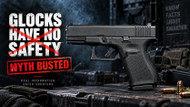
GLOCKs Have No Safety!
Posted by Mr GunBuster on Sep 28th 2026
IronKells Armory | GunBusters
GLOCKs Have No Safety
No thumb lever does not mean no safeties. Glock built the safety system into the trigger and fire-control system instead of hanging a switch off the side of the pistol.
Verdict
BUSTED.
Standard Glock pistols do not normally use a conventional external thumb safety. They do use three automatic mechanical safeties: a trigger safety, firing-pin safety and drop safety. Those systems remain engaged until the trigger moves through the firing sequence.
The Claim
“Glocks don't have safeties.”
We've all heard some version of it.
Usually the person saying it looks at a Glock, doesn't see the thumb lever found on something like a 1911, and decides nothing is preventing that pistol from firing except luck.
The mistake is assuming that “safety” means “manual lever.”
Why This Myth Refuses to Die
Traditional handgun safeties are easy to understand because you can see them.
Lever up.
Lever down.
SAFE.
FIRE.
A Glock doesn't normally give you that visual cue.
Instead, Glock designed the safety system so the protection is automatic. You don't consciously disengage three different safeties before firing. The movement of the trigger does that for you in sequence.
That makes the pistol extremely simple to operate.
It also makes the safeties easier for somebody unfamiliar with the design to overlook.
The safeties aren't missing. Most of them are simply inside the damn gun.
The Glock Safety Stack
Glock calls the system Safe Action.
It uses three passive, independently operating mechanical safeties:
| Safety | What It Blocks | How It Disengages |
|---|---|---|
| Trigger Safety | Rearward trigger movement | Center trigger lever and trigger are deliberately pressed together |
| Firing-Pin Safety | Forward movement of the striker / firing pin | Trigger bar lifts the safety plunger during the trigger press |
| Drop Safety | Release of the striker from the trigger-bar engagement | Trigger bar travels down the safety ramp near the end of the trigger press |
All three disengage as part of the firing sequence and automatically re-engage when the trigger returns forward.
Safety #1: Trigger Safety
This is the one safety everybody can actually see.
The spring-loaded lever in the center of the trigger projects forward when the trigger is at rest.
In that position, it physically prevents the trigger from traveling rearward.
To fire the pistol, the center lever and main trigger shoe have to move together.
Glock specifically says this safety is intended to help prevent firing if the pistol is dropped or if lateral force is applied to the trigger rather than a normal rearward trigger press.
That distinction matters.
The trigger safety is not an electronic sensor.
It does not know whether the object touching the trigger is your trigger finger, a piece of clothing, a drawstring or something else.
If something enters the trigger guard, depresses the center lever and moves the entire trigger rearward, the safety has been intentionally bypassed by exactly the kind of movement it was designed to recognize.
The Trigger Safety Is Not a Force Field
This is where people sometimes swing too far the other direction.
Yes, Glock has a trigger safety.
No, that doesn't mean anything can bounce around inside your trigger guard without consequence.
A quality holster and keeping unwanted objects away from the trigger remain critical because an object that actually presses the trigger can operate the firing sequence normally.
Safety #2: Firing-Pin Safety
Inside the slide is a spring-loaded safety plunger.
At rest, that plunger mechanically blocks the firing pin from traveling forward.
This is important because we're not merely relying on the firing-pin spring to keep the striker away from the primer.
There's an actual mechanical obstruction in the striker's path.
As the trigger moves rearward, the vertical extension on the trigger bar pushes the firing-pin safety upward.
Only then does the striker's forward path become clear.
If the shooter starts pressing the trigger and then releases it before firing, the plunger automatically returns to its blocking position.
So until the trigger sequence actually moves that block, the striker does not have a normal open path to the primer.
Safety #3: Drop Safety
The third safety is built into the relationship between the trigger bar, trigger mechanism housing and striker.
With the trigger forward, the trigger bar rests on a safety ramp inside the trigger mechanism housing.
The rear portion of the trigger bar engages the striker and prevents it from simply moving forward.
As the trigger moves rearward, the trigger bar travels through its designed path.
Near the end of that press, the connector guides the trigger bar downward.
That's when the trigger bar releases the striker.
After the pistol cycles and the trigger resets, the trigger bar rises again and the system returns to its normal protected condition.
The striker is not supposed to simply jump off the trigger bar because the pistol took a hit.
What Does “Partially Cocked” Actually Mean?
Another piece of Glock folklore is that the striker is sitting fully cocked behind a live primer with nothing but the trigger holding it back.
That's not how Glock describes the traditional Safe Action system.
When a standard Glock is in its ready-to-fire condition, Glock's manual states that the firing-pin spring is under partial tension.
As the trigger moves rearward, the trigger bar continues moving the striker and further compressing the firing-pin spring.
At the same time, the firing-pin safety is being moved out of the way.
Near the end of the press, the trigger bar drops and releases the striker.
That's why reducing the entire design to “cocked striker + no safety lever” misses most of what is actually happening.
What Happens During One Trigger Press
- The trigger safety is depressed. The trigger is now able to move rearward.
- The trigger bar begins moving rearward. The striker spring is being further tensioned.
- The trigger bar lifts the firing-pin safety. The mechanical block is removed from the firing pin's path.
- The trigger bar continues rearward while retaining the striker.
- The connector guides the trigger bar downward.
- The striker is released.
- The cartridge fires and the slide cycles.
- The trigger system resets.
- The safeties automatically re-engage as the trigger returns forward.
Manual Safety vs. Passive Safety
A conventional manual safety requires the shooter to deliberately switch the firearm between safe and fire conditions.
Glock's system is passive.
The shooter doesn't perform an extra motion before firing.
The safeties are engaged automatically whenever the pistol is in its normal ready condition and the trigger is forward.
The act of pulling the trigger simultaneously begins the firing sequence and removes the protections necessary for that firing sequence to occur.
Different design philosophy. Still a safety system.
And Yes — If Something Pulls the Trigger, the Pistol Can Fire
The Safe Action system is designed to prevent unintended mechanical discharge.
It is not designed to prevent the pistol from firing after the trigger has been properly moved through its firing stroke.
That sounds obvious, but it's one of the most important things to understand about carrying a pistol without a conventional manual safety.
The trigger needs to stay protected until you actually intend to fire.
Why the Holster Matters So Much
For a carried Glock, the holster becomes a major part of real-world risk management.
Not because the holster is one of Glock's three internal safeties.
Because it protects the thing that operates all three of them:
the trigger.
A serious holster should give you:
- Full trigger-guard coverage
- Rigid protection around the trigger area
- Stable retention
- No collapsing material that can enter the trigger guard
- No exposed gaps large enough for random objects to reach the trigger
During reholstering, loose clothing, drawstrings and other objects need to stay clear.
The internal safeties cannot distinguish your finger from a hoodie cord if either one presses the trigger correctly.
What About Dropping a Glock?
Drop safety is built directly into the reason those three systems exist.
Glock specifically describes the Safe Action system as safe if the pistol is dropped.
The trigger safety resists unintended trigger movement.
The firing-pin safety physically blocks forward striker movement.
The trigger-bar drop safety keeps the striker engaged until the normal trigger sequence releases it.
Those are independent layers doing different jobs.
That is substantially different from relying on one single spring to hopefully keep everything in place during impact.
Drop Safety Isn't Just Marketing Language
Formal handgun safety testing gives us a useful example of how drop safety is evaluated independently of manufacturer advertising.
California's handgun testing process, for example, requires tested handguns to undergo drop testing at approximately one meter onto concrete.
The current California compliance report identifies six orientations:
- Normal firing position
- Upside down
- On the grip
- On the muzzle
- On either side
- On the rear / exposed hammer or striker area when applicable
The tested handgun samples must not fire the primer during those drops.
That doesn't mean a standardized test proves a firearm is physically incapable of failing under every imaginable abuse condition.
It does show that drop safety is something firearm designs are actually tested for—not merely a phrase somebody printed on a brochure.
What We're Changing From the Original Forge File
The original article suggested recreating drop testing with primed cases and controlled drops.
We're not carrying that forward.
Formal drop tests are conducted using controlled fixtures, defined orientations, specified surfaces, test procedures and containment.
You don't gain much by trying to recreate laboratory impact testing in the garage.
For a real firearm, manufacturer documentation, proper inspection and correct function verification make more sense than intentionally throwing the pistol around.
Aftermarket Trigger Parts Can Change the Safety System
This is where the conversation becomes more important for people who actually modify Glocks.
A Glock can leave the factory with correctly engineered safety geometry and later have that geometry changed.
Trigger work can affect:
- Trigger-safety engagement
- Pre-travel
- Firing-pin-safety timing
- Trigger-bar / striker engagement
- Connector timing
- Over-travel
- Reset
That does not mean aftermarket triggers are automatically unsafe.
Glock itself sells the Glock Performance Trigger, which changes the trigger architecture while Glock states that it retains the safety features of the Safe Action system.
That's proof that better trigger feel and intact safety mechanisms are not mutually exclusive.
The problem is not “aftermarket.” The problem is incorrect geometry, incorrect installation or tuning past the point where the safety system still works correctly.
Trigger-Modification Red Flags
After trigger work, these are things we don't ignore:
- Trigger safety no longer positively blocks the trigger
- Trigger can move significantly without the safety lever depressed
- Pre-travel has been adjusted nearly completely out
- Firing-pin safety appears partially disengaged at rest
- Questionable trigger-bar / striker engagement
- Inconsistent reset
- Striker releases unexpectedly
- Unexpected doubling
- Gun behaves differently depending on slide manipulation
- Parts have been ground or re-angled without a clear understanding of what those surfaces do
If the safety system isn't functioning properly, the fact that the trigger feels amazing doesn't mean shit.
What We Verify After Trigger Work
We don't need to recreate a laboratory drop test.
We do want the unloaded pistol's safety mechanisms checked correctly before live-fire verification.
At a minimum, we're concerned with whether:
- The trigger safety still positively blocks rearward trigger movement when it isn't depressed
- The firing-pin safety continues to mechanically block striker movement when it should
- The trigger bar retains proper engagement
- The trigger resets consistently
- No binding or unexpected release is present
- The pistol operates normally during subsequent live-fire testing
If something fails a proper safety/function check, the firearm doesn't go back into service until the cause is corrected.
What This Means for Carry
The Safe Action system is built around the assumption that the trigger stays protected until the shooter wants the gun to fire.
For a carry setup, that means we want:
- All three safeties functioning normally
- A quality holster
- Full trigger-guard coverage
- No random shit inside the holster
- Controlled reholstering
- No questionable trigger modifications
- A trigger appropriate for the job
A Glock does not need a thumb safety to be mechanically safe.
That also doesn't mean carrying one excuses careless trigger discipline.
Myth vs. Reality
| Myth | Reality |
|---|---|
| Glocks have no safeties. | The Safe Action system uses three passive mechanical safeties. |
| The trigger tab is the only safety. | It is only the first of three. |
| A safety must be an external lever. | Safeties can be passive, automatic and internal. |
| A Glock can just fire if bumped. | Its safety system is specifically designed to prevent impact alone from completing the firing sequence. |
| Internal safeties mean nothing can accidentally fire it. | An object that actually depresses and moves the trigger can still operate the pistol normally. |
| Any aftermarket trigger removes the Glock safeties. | Properly engineered systems can retain them. Incorrect geometry or adjustment can interfere with them. |
| Drop safe means mechanically impossible to fail. | It means the firearm is designed and tested to resist impact-driven discharge under specified conditions. Mechanical inspection still matters. |
Why Glock Chose This Design
The advantage is simplicity.
The shooter draws the pistol and the pistol is ready to operate without an additional control that has to be disengaged first.
For military, law-enforcement and defensive use, that means the manual of arms stays simple under stress.
The trade-off is equally obvious:
there is no conventional manual switch stopping a complete trigger press.
The system puts heavy importance on:
- Proper trigger discipline
- Proper holster selection
- Proper handling
- Proper maintenance
- Properly installed trigger components
That's not a defect. It's the operating philosophy of the platform.
The IronKells Takeaway
Don't be scared of a Glock because it doesn't have a thumb lever.
And don't become careless because somebody told you Glock has three safeties.
Understand what each safety is actually doing.
Understand what defeats those safeties.
Keep the trigger protected.
Don't grind safety geometry away trying to win a trigger-pull contest.
Then let the pistol do exactly what it was designed to do.
Related Forge Files
Glock Safe Action System
The full technical breakdown of the three safeties, firing sequence, trigger modifications and carry considerations.
Glock Trigger Upgrade Guide
Connectors, trigger shoes, striker springs, safety geometry and carry-versus-competition tuning.
Glock Holster Fitment
Trigger coverage, retention, weapon lights, optics and modified carry setups.
GunBusters: Light Triggers Are Unsafe
Why pull weight alone does not tell you whether a trigger system is mechanically safe.
Bottom Line
Glocks have safeties.
Three of them.
The trigger safety blocks unintended trigger movement.
The firing-pin safety physically blocks the striker.
The drop safety keeps the trigger bar and striker engaged until the firing sequence releases them.
They work automatically.
They reset automatically.
And none of them excuse bad handling.
So when somebody says, “Glocks have no safety,” the answer is simple: they're looking for a lever instead of understanding how the damn pistol actually works.
Sources & Receipts
| Source | Used For |
|---|---|
| Original IronKells Forge File — GLOCKs Have No Safety | Original myth framing, safety-stack explanation, practical handling discussion, drop-test context and Forge Files perspective |
| GLOCK — Safe Action System | Current official explanation of trigger safety, firing-pin safety, drop safety, firing sequence and automatic re-engagement |
| GLOCK — Current Owner's Manual / Instructions for Use | Ready-to-fire condition, partial firing-pin spring tension, internal safety operation and safe-handling context |
| GLOCK — Safety FAQ | Confirmation of three passive independently operating safeties and their individual functions |
| GLOCK — Performance Trigger Information | Example of a modified trigger architecture retaining Safe Action safety features |
| California DOJ — Handgun Compliance / Drop Safety Test | Current standardized one-meter, six-orientation handgun drop-test framework |
| IronKells / Builder Experience | Trigger modifications, holster use, carry setups and practical safety verification |
IRONKELLS ARMORY | GUNBUSTERS
Myth Busted.
No lever doesn't mean no safety. Know the system before repeating the folklore.