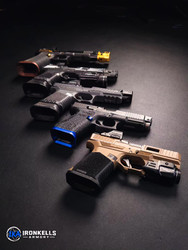
Glock Safe Action System
Posted by Some Loser on Sep 28th 2026
Glock Safe Action System
The trigger safety, firing-pin safety and drop safety — what they actually do, what they don't do, why a Glock doesn't need a thumb lever to have safeties, and what can go wrong when trigger geometry gets modified badly.
IronKells Armory | Glock | Safety & Function
“Glocks don't have safeties.”
We've heard that shit forever.
What people usually mean is:
Glocks don't normally have a conventional external thumb safety that the shooter flips on and off.
That's true.
Saying the pistol has no safeties is not.
The traditional Glock Safe Action system uses three automatic mechanical safeties that stay engaged until the trigger is deliberately moved through the firing sequence.
They don't require you to remember to flip a lever.
They also don't protect you from doing something stupid with the trigger.
Understanding both sides of that is the whole point.
“No thumb lever does not mean no safety. It means the safeties are working inside the gun instead of hanging off the side.”
The Fast Summary
Safety #1 — Trigger Safety. The center lever blocks rearward trigger movement unless it is depressed with the trigger.
Safety #2 — Firing-Pin Safety. A spring-loaded plunger physically blocks forward striker travel until the trigger bar lifts it out of the way.
Safety #3 — Drop Safety. The trigger bar holds the striker lug and stays supported on the safety ramp until the trigger is deliberately pulled far enough to release the striker.
They work together. Pulling the trigger sequentially removes all three protections. Releasing the trigger allows them to re-engage.
A Glock will fire if the trigger is properly pressed with a chambered round. There is no thumb safety standing between you and a bad trigger press.
Aftermarket trigger parts can change safety geometry. Light pull weight alone isn't automatically unsafe, but defeating the actual safety mechanisms sure as hell is.
The Three-Safety Stack
| Safety | What It Blocks | How It Disengages |
|---|---|---|
| Trigger Safety | Rearward trigger movement | Center trigger lever is deliberately depressed along with the trigger |
| Firing-Pin Safety | Forward striker movement toward the primer | Trigger-bar extension lifts the plunger during trigger travel |
| Drop Safety | Striker release from the trigger-bar engagement | Connector cams the trigger bar downward near the end of the trigger press |
The entire system is built around one idea: the normal firing sequence should only happen when the trigger is actually being pressed.
1. Trigger Safety
The little lever in the middle of a Glock trigger isn't decoration.
When the trigger is forward, that lever projects outward and prevents the main trigger shoe from moving rearward.
Press the center lever flush with the trigger and the trigger is now free to move.
Its job is largely to prevent the trigger from moving from inertia, side pressure, impact or other forces that don't resemble a deliberate straight trigger press.
Simple part. Important job.
What the trigger safety does NOT do: it does not magically recognize your finger. Clothing, a drawstring, a poorly designed holster or another object that gets inside the trigger guard and depresses both the center lever and trigger can fire the pistol just like a finger can.
2. Firing-Pin Safety
Inside the slide is a spring-loaded safety plunger.
At rest, that plunger physically blocks the striker from traveling forward far enough to reach the cartridge primer.
During the trigger press, the vertical extension on the trigger bar moves underneath the safety plunger and pushes it upward.
Only then is the striker's forward path opened.
Release the trigger and the plunger drops back into position.
This is a physical block — not merely spring tension trying to hold the striker back.
3. Drop Safety
The rear section of the trigger bar engages the striker lug.
With the trigger forward, the trigger bar is supported on the safety ramp inside the trigger mechanism housing.
That prevents the trigger bar from simply dropping away and releasing the striker because the gun was bumped or dropped.
As the trigger reaches the end of its deliberate rearward movement, the connector guides the trigger bar downward.
That's when the striker is released.
No complete trigger sequence, no normal striker release.
The Striker Isn't Just Sitting There Fully Released Against the Primer
Another thing people oversimplify:
In the traditional Safe Action system, the striker spring is under partial tension when the pistol is ready to fire.
The trigger press moves the trigger bar rearward, increasing striker-spring tension while simultaneously working through the safety sequence.
Near the end of the press, the trigger bar is cammed downward and releases the striker.
That's part of why calling the Glock system exactly the same as every other striker-fired pistol isn't very useful.
What Happens During One Trigger Press
- Finger presses the trigger safety. The trigger is now free to move rearward.
- Trigger and trigger bar begin moving rearward.
- The trigger-bar extension lifts the firing-pin safety. The striker path becomes clear.
- The trigger bar continues controlling and tensioning the striker.
- The connector guides the trigger bar downward near the end of the press.
- The trigger bar releases the striker.
- The pistol fires.
- The slide cycles and the trigger system resets.
- As the trigger is released forward, the automatic safeties re-engage.
That's why Glock calls it Safe Action instead of “one little safety lever.”
“No Manual Safety” Is Not the Same as “No Safety”
Traditional manual safeties normally require the shooter to deliberately move some external lever between safe and fire.
Glock's safeties are automatic.
They don't ask you to flip anything before firing.
That makes the gun simple to operate.
It also means the trigger itself becomes extremely important.
If something correctly presses the trigger far enough rearward, the Safe Action system is doing exactly what it was designed to do when it fires the pistol.
The Holster Is Part of the Safety System in Real Life
Not mechanically inside the pistol.
Practically?
Absolutely.
A proper holster should prevent random shit from getting to the trigger while the pistol is being carried.
We want:
- Trigger guard fully protected
- Rigid enough material that it doesn't collapse into the trigger
- Correct retention
- No exposed trigger because somebody cut the holster too aggressively
- Nothing inside the holster that can press the trigger during reholstering
See the Glock Holster Fitment Guide for the rest of that conversation.
Reholstering Is Where People Defeat All Three Safeties at Once
Think about how the system works.
If a piece of clothing, drawstring or holster material gets inside the trigger guard and presses the trigger:
- The trigger safety gets depressed.
- The trigger bar begins moving.
- The firing-pin safety gets lifted.
- The drop safety is eventually released.
- The pistol can fire.
Nothing “failed.”
The safeties followed their normal sequence because something pulled the trigger.
That is why reholstering is not something we race.
Is a Glock Drop Safe?
The Safe Action system is specifically designed to prevent the pistol from firing merely because it is dropped or receives an impact.
That's what the trigger safety, firing-pin block and trigger-bar drop safety are doing together.
But “drop safe” doesn't mean:
- Every broken or modified Glock is automatically safe
- You should intentionally throw your gun around to test it
- Mechanical parts can never fail
- A homemade trigger job can't defeat safety geometry
A properly assembled, functioning Glock is designed around drop safety. That's different from saying physics can never break anything under any circumstance.
We're removing one thing from the old Forge File: we do not recommend homemade drop testing with primed cases or repeatedly throwing a pistol onto concrete. Proper drop testing belongs in controlled test protocols. For shop work, we verify the actual safety mechanisms and function instead of trying to recreate a laboratory drop test in the garage.
Aftermarket Triggers: This Is Where Safety Geometry Actually Matters
We're not anti-aftermarket trigger.
Hell, we've run tuned Glock triggers down into competition pull weights for huge round counts.
What matters is whether the three safety functions are still doing their jobs.
Trigger work can affect things such as:
- Trigger-safety engagement
- Pre-travel
- Firing-pin-safety timing
- Trigger-bar / striker engagement
- Connector timing
- Reset
A properly engineered light trigger can retain the safety system.
A badly fitted five-pound trigger can be unsafe.
Trigger weight is one number. Geometry is the bigger story.
Are Light Glock Triggers Unsafe?
Not automatically.
We've run light Glock competition triggers safely and reliably.
But lighter triggers absolutely reduce the amount of force necessary to fire the pistol.
That means the shooter has less physical margin for a bad trigger press.
Mechanical safety and human margin are two different questions.
A 2.5 lb trigger can mechanically preserve the safeties and still be less forgiving of careless handling than a 5 lb trigger.
That's why the trigger setup should match the job.
The Biggest Trigger-Job Red Flags
Things that make us stop and inspect the setup:
- Trigger safety no longer projects fully when the trigger is forward
- Trigger can move rearward without properly depressing the safety tab
- Pre-travel adjusted nearly completely out
- Firing-pin safety appears partially lifted before the trigger is deliberately pressed
- Poor or questionable striker/trigger-bar engagement
- Trigger won't reliably reset
- Striker releases unexpectedly during cycling or manipulation
- Parts were ground or re-angled without understanding the engagement geometry
That's not “performance tuning.” That's a gun asking to be fixed.
What About the Glock Performance Trigger?
The Glock Performance Trigger changes the trigger architecture compared with a traditional Glock trigger group.
It uses a different sear arrangement to improve pull characteristics.
But Glock specifically designed it to retain the safety features of the Safe Action system.
That's the important part:
You can change trigger feel without abandoning the underlying safety goals.
For the deeper trigger discussion, see the Glock Trigger Upgrade Guide .
Gen6 Still Uses Safe Action
Gen6 introduced a new flat-faced factory trigger and changed plenty of other parts of the pistol.
Glock still kept the Safe Action safety architecture.
So a different trigger shoe doesn't mean the three-safety idea disappeared with the generation change.
Safe Action Myths That Need to Die
“Glocks have no safeties.”
Wrong. They normally have no conventional manual thumb safety. That's not the same statement.
“The trigger tab will stop anything except a finger.”
Wrong. Anything that depresses the tab and moves the trigger can operate the firing sequence.
“Drop safe means impossible to fire accidentally.”
Wrong. Drop safety protects against impact-driven discharge. It does not protect against something actually pressing the trigger.
“Light triggers automatically defeat drop safety.”
Wrong. Bad engagement geometry can defeat safety. Pull weight alone does not tell you whether the safety mechanisms still function.
“A manual thumb safety is the only real safety.”
Wrong. Mechanical safeties can be automatic, passive and internal.
“Internal safeties mean handling doesn't matter.”
Probably the dumbest one of all.
After Trigger Work, We Verify the Safety Stack
Any time the trigger system is changed, we're not satisfied because the trigger feels good.
We want to know:
- Trigger safety still blocks trigger movement when it isn't intentionally depressed
- Firing-pin safety still positively blocks striker movement when it should
- Trigger-bar / striker engagement is correct
- Trigger resets positively
- No binding or unexpected release occurs
- Live-fire function remains normal after unloaded safety checks are complete
If any safety isn't working correctly:
the gun doesn't get used until the problem is corrected.
Pretty simple.
Carry Gun: What Matters to Us
For a Glock that's actually being carried, our priorities are boring:
- All safeties remain fully functional
- Trigger safety has positive engagement
- Broad reliability margin
- Positive reset
- Quality holster that fully covers the trigger
- Nothing inside the holster
- No stupid race to reholster
A carry gun does not need to impress anybody on a trigger gauge.
Competition Gun: You Can Tune It Without Making It Sketchy
We've run light competition Glock triggers.
They can be fantastic.
The correct approach is not:
“How much safety can I remove to get to two pounds?”
It's:
“How good can I make this trigger while keeping the mechanisms doing what they're supposed to do?”
Those are very different mindsets.
Common Glock Safety Questions
Does a Glock have a safety?
Yes. The Safe Action system uses a trigger safety, firing-pin safety and drop safety. Standard Glock pistols simply don't use a conventional manual thumb safety.
Can a Glock fire if dropped?
The properly functioning Safe Action system is specifically designed to prevent discharge from ordinary drops and impact by keeping the trigger, striker path and trigger-bar/striker relationship blocked until the firing sequence occurs.
Will the trigger safety stop clothing from firing the gun?
Not if the object gets into the trigger guard and presses the center safety lever and trigger together. That's why holster and reholstering discipline matter.
Are aftermarket Glock triggers safe?
Quality, correctly installed trigger systems can preserve the Glock safety mechanisms. Poorly fitted or over-adjusted parts can interfere with them. Brand name alone doesn't replace inspection and testing.
Is a 2.5 lb Glock trigger unsafe?
Pull weight by itself doesn't answer whether the mechanical safeties function. It does affect how much force is needed to fire the pistol, so intended use and handling margin matter too.
Does the Glock Performance Trigger keep the Safe Action system?
Yes. Glock specifically says the Performance Trigger maintains the safety features of the Safe Action system even though its internal trigger architecture differs.
Does Gen6 still have the three Glock safeties?
Yes. Gen6 introduced a flat-faced trigger but retains Glock's Safe Action safety system.
Related Forge Files
Glock Trigger Upgrade Guide
Connectors, trigger shoes, striker springs, carry and competition trigger setups.
Glock Holster Fitment
Trigger coverage, retention, weapon lights and carry configuration.
Glock Light Primer Strikes
Striker springs, primer ignition and tuned trigger systems.
Glock Cleaning & Lubrication
Trigger system, striker channel and maintenance.
Bottom Line
Glocks have safeties.
Three of them.
The trigger safety blocks trigger movement.
The firing-pin safety blocks the striker.
The drop safety keeps the striker engaged until the trigger sequence releases it.
They work automatically.
They also do not excuse bad handling.
Keep the trigger protected. Keep the safety geometry intact. Then let the Safe Action system do the job it was built to do.
Know What the Gun Is Doing.
A safety system works a hell of a lot better when the person carrying the gun understands it.
Glock Forge Files Trigger Upgrade GuideSource List / Receipts
This guide combines the original IronKells Glock safety GunBusters, our trigger/build experience, and current Glock Safe Action information.
| ID | Source | Used For |
|---|---|---|
| S1 | Original IronKells — GLOCKs Have No Safety! | Original myth breakdown, three-safety explanation and practical Safe Action discussion |
| S2 | Original IronKells — Drop Safety: Truth vs Fear Mongering | Drop-safety mechanics, trigger inertia and myth discussion |
| S3 | Original IronKells — Light Triggers Are Unsafe! | Trigger weight vs safety geometry, aftermarket trigger concerns and practical trigger philosophy |
| S4 | GLOCK Safe Action System | Current trigger safety, firing-pin safety, drop safety and reset sequence |
| S5 | GLOCK Owner's Manual | Safe Action mechanics, partial striker tension and no conventional manual-safety warning |
| S6 | GLOCK Performance Trigger Information | Performance Trigger retaining Safe Action safety features |
| S7 | GLOCK Gen6 Information | Gen6 flat-faced trigger and continued Safe Action system |
| S8 | IronKells / Builder Experience | Tuned triggers, carry vs competition setups, holsters and practical safety verification |
IRONKELLS ARMORY | FORGE FILES
Receipts Over Rumors.
Understand the system. Keep the safeties intact. Keep your damn finger off the trigger until you mean it.