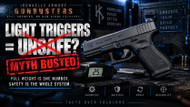
Light Triggers Are Unsafe
Posted by Mr. Gunbuster on Sep 29th 2026
IronKells Armory | GunBusters
Light Triggers Are Unsafe
Does reducing trigger pull automatically make a handgun dangerous? Pull weight, safety geometry, striker and sear engagement, drop safety, carry guns, competition guns, marksmanship, holsters, and the difference between a properly tuned trigger and a bad trigger job.
Verdict
MOSTLY BUSTED.
A lighter trigger is not automatically mechanically unsafe. A properly engineered trigger can have a significantly lighter pull while preserving the firearm's trigger safety, firing-pin or striker block, drop safety, sear engagement and reliable reset. But lighter pull weight does reduce the amount of force required to fire the gun, so handling margin, intended use, holster quality and proper installation matter more as the trigger gets lighter.
The Claim
“Any lighter trigger is a negligent discharge waiting to happen.”
Or:
“Anything under 4 or 5 pounds is unsafe.”
Or the classic:
“Never modify a carry-gun trigger.”
Those statements all sound simple enough to be useful.
The problem is that trigger systems aren't simple enough for pull weight alone to tell you whether the firearm is mechanically safe.
Why This Myth Exists
There are legitimate reasons people are cautious about light triggers.
1. Bad Trigger Jobs Are Real
We've all seen somebody attack a fire-control system with a polishing wheel, stone or Dremel without understanding what those surfaces actually do.
Then the trigger becomes lighter because engagement has been reduced, angles have changed or the safety system is already partially defeated.
That isn't the same thing as an engineered trigger system.
2. People Confuse Pull Weight With Safety Engagement
A trigger gauge gives you one number.
It does not tell you:
- How much sear engagement exists
- Whether the firing-pin block works correctly
- Whether the drop safety remains engaged
- Whether the trigger safety works
- Whether the trigger resets correctly
- Whether the system remains stable during impact
3. Very Light Competition Triggers Get Compared to Carry Guns
A two-pound competition trigger and a five-pound carry trigger have different jobs.
Treating them like the same use case makes every conversation stupid before it starts.
4. Heavy Trigger Policies Get Mistaken for Mechanical Laws
Some agencies and jurisdictions historically chose very heavy trigger pulls as an additional handling margin.
That doesn't prove every lighter trigger is mechanically unsafe.
It proves administrators sometimes choose more required trigger force as one part of their overall risk strategy.
There Are Actually Two Different Safety Questions
Question #1: Is the trigger mechanically safe?
Do the safety mechanisms, engagement surfaces and reset function correctly?
Question #2: Is that trigger appropriate for how this gun will be used?
Does the pull weight provide enough handling margin for daily carry, duty use, competition or whatever job the firearm actually has?
A trigger can pass the first question and still not be our favorite answer to the second.
What Actually Makes a Trigger Mechanically Safe?
The answer depends on the firearm, but the major themes are remarkably consistent.
| System | What We Care About |
|---|---|
| Trigger Safety | Still positively blocks normal trigger movement until deliberately depressed. |
| Firing-Pin / Striker Block | Remains fully engaged until the intended trigger sequence moves it out of the way. |
| Sear / Striker Engagement | Sufficient engagement remains to prevent unintended release from impact, cycling or normal manipulation. |
| Drop Safety | The firing mechanism remains secured until the designed trigger stroke occurs. |
| Reset | Trigger returns and re-engages reliably every time. |
| Installation | Parts fit correctly and stay inside the manufacturer's intended geometry. |
None of those questions can be answered by looking only at “3.5 lb” on a trigger gauge.
Glock Is a Great Example
Glock's Safe Action system uses three automatic mechanical safeties:
- Trigger safety
- Firing-pin safety
- Drop safety
Those systems do specific mechanical jobs.
The trigger safety blocks rearward trigger movement.
The firing-pin safety physically blocks the striker.
The drop safety keeps the trigger bar and striker relationship secured until the firing stroke deliberately releases it.
Changing the trigger pull from five pounds to four pounds does not automatically erase those mechanisms.
Changing the geometry so they no longer function correctly absolutely can.
A Real Example: Timney Alpha
The Timney Alpha Competition trigger is a useful example because it changes the architecture of the traditional Glock trigger while producing a much lighter break.
Instead of the traditional Glock trigger bar doing all the work of pulling and releasing the striker, Timney uses a separate sear housing.
With stock factory components, Timney has documented break weights around the three-pound neighborhood.
More importantly for this conversation, all three factory Glock safeties remain functional when the system is installed and adjusted correctly.
That's strong evidence against the idea that:
“Three pounds automatically means the safety system has been deleted.”
But Timney also provides an equally important warning:
the trigger's pre-travel adjustment can be taken too far.
Remove too much pre-travel and you can begin partially disengaging the Glock safety mechanisms before the trigger is intentionally pressed.
That's the entire GunBuster in one example: the three-pound pull isn't the problem. Incorrect geometry is.
Pre-Travel: Where People Get Too Greedy
A little pre-travel bothers people because it feels like wasted motion.
So they try to remove every last bit of it.
The problem is that pre-travel isn't always just empty space.
During that initial trigger movement, the firing system may be:
- Depressing a trigger safety
- Beginning to move a trigger bar
- Preparing to lift a firing-pin block
- Maintaining required sear or striker engagement
Take too much travel out and the gun can begin sitting at rest with a safety already partly disengaged.
That is very different from simply making the trigger lighter.
Sear & Striker Engagement
The firing mechanism has to hold the striker or hammer securely until the intended release point.
If somebody gets a lighter trigger by reducing engagement too far, you've now changed the amount of mechanical overlap holding the firing system in place.
That can show up as:
- Unexpected release
- Release during cycling
- Poor drop safety
- Inconsistent reset
- Doubling
- A trigger that changes behavior as parts wear
That's why we don't blindly polish or reshape engagement surfaces simply because smoother metal feels nice.
Smoothness is good. Deleting the geometry that actually holds the gun safe is not.
The Firing-Pin Block Has to Stay a Block
A firing-pin or striker block is one of the most important protections in a modern handgun.
At rest, it should physically prevent forward striker movement.
The trigger sequence removes that block at the proper time.
If an aftermarket trigger bar, badly adjusted pre-travel system or improperly fitted part leaves that block partially lifted while the gun is sitting at rest, that is an actual safety problem.
Again: nothing about that problem is described by the number on the trigger gauge.
A Light Trigger That Doesn't Reset Is Garbage
Reset gets ignored because everybody wants to talk about pull weight.
But the gun needs to:
- Release correctly
- Cycle correctly
- Reset correctly
- Re-engage the relevant safety mechanisms correctly
- Do it every single time
A beautiful 2.5 lb break means nothing if the trigger occasionally hangs forward, fails to reset or releases the striker unexpectedly.
Reliability is part of safety.
Stacked Modifications Are Where Things Get Weird
One properly engineered change is easy to evaluate.
Then somebody adds:
- Aftermarket trigger shoe
- Different trigger bar
- Aftermarket connector
- Reduced striker spring
- Reduced safety-plunger spring
- Lightened striker
- Travel-adjustment screws
- Hand-polished engagement surfaces
Every individual part may be perfectly good.
The combination can still stack tolerances in a way no individual manufacturer tested.
That's why Forge Files keeps hammering on one principle:
Change one variable at a time whenever you can.
When something starts acting weird, you want to know what changed.
Trigger Weight and Ignition Reliability Are Connected Too
One traditional way to lighten a striker-fired trigger is to reduce striker-spring weight.
That can absolutely work.
We've run competition Glocks with light striker springs for very high round counts successfully.
But that same spring is also responsible for delivering energy to the primer.
Take too much away and now the pistol may become ammunition-sensitive or start producing light strikes.
That's not a drop-safety problem.
It's an ignition-margin problem.
Still part of the same lesson: trigger tuning affects an entire system, not just pull weight.
Why Lighter Triggers Can Be Easier to Shoot Well
A handgun is relatively light.
The shooter is trying to keep the sights or dot aligned while adding rearward pressure to the trigger.
The more force required, the more opportunity there is for the shooter to add unwanted movement to the gun.
That doesn't mean skilled shooters can't shoot heavy triggers extremely well.
They absolutely can.
It means a cleaner, lighter and more predictable trigger generally asks less of the shooter during the final part of the firing process.
That's why competition guns aren't normally equipped with twelve-pound triggers for fun.
A Useful Real-World Example: NYPD Trigger Weight
NYPD historically became famous for unusually heavy handgun trigger pulls.
The idea was understandable:
more trigger force could provide an extra physical buffer against an unintended press.
But eventually the department tested recruits with substantially lighter triggers.
In a reported test of 457 recruits, the average score with the roughly five-pound trigger was 93.7 compared with 88.7 using the roughly twelve-pound trigger.
Sworn officers tested also reportedly shot better with the lighter system.
That does not prove:
“Lighter triggers are always safer.”
What it does prove is that trigger weight can meaningfully affect shooting performance.
If somebody tells you adding six pounds of trigger resistance has absolutely no downside, that's just as simplistic as saying every light trigger is safe.
But the Heavy-Trigger Argument Isn't Completely Stupid Either
Research on police movement and involuntary trigger pressure illustrates why heavier triggers were attractive to agencies in the first place.
In one series of experiments involving vigorous movements while participants had their finger on an instrumented trigger, some subjects unintentionally generated enough pressure to fire a roughly five-pound single-action trigger, while fewer generated enough pressure to overcome a roughly twelve-pound trigger.
That's important.
It tells us a heavier trigger can provide additional physical margin when a finger is already where it should not be.
But it also reveals the deeper problem:
the finger was on the trigger.
Hardware can add margin. It cannot replace trigger discipline.
Carry vs. Competition: Different Jobs
| Priority | Carry / General Purpose | Competition |
|---|---|---|
| Pull Weight | Moderate and predictable; enough handling margin for uncontrolled environments | Can be significantly lighter when appropriate to the sport and setup |
| Reset | Positive, reliable and easy to confirm | Often shorter and faster |
| Ammo Tolerance | Broad | May be tuned around known match ammunition |
| Maintenance Environment | Lint, dirt, sweat, daily carry and long intervals between inspections | Often cleaned, inspected and serviced more frequently |
| Safety Geometry | Must remain correct | Still must remain correct |
Our Carry-Gun Philosophy
For a normal carry or general-purpose handgun, we're not chasing the lowest possible number.
We want:
- A clean wall
- Predictable break
- Positive reset
- All factory safety functions intact
- Broad ammunition reliability
- A trigger weight that still gives us reasonable handling margin
Something roughly around the four-to-five-pound neighborhood can be an excellent place to live on a properly tuned carry-style handgun.
That's not because four pounds is magically safe and 3.9 pounds suddenly becomes dangerous.
There's no invisible cliff there.
It's simply a practical range we like because you can gain a much better trigger without chasing race-gun pull weights on a gun that lives in a holster every day.
Competition Changes the Equation
We've run very light Glock competition triggers.
They can be fantastic.
A two-to-three-pound trigger with a defined wall and extremely short reset can make a purpose-built competition pistol easier to run quickly and precisely.
That doesn't make it the trigger we'd blindly put into every concealed-carry pistol.
The competition gun:
- Lives in a more controlled environment
- Gets inspected more often
- May be tuned to specific ammunition
- Is handled within a specific sporting context
- Is being optimized around speed and precision
Different job. Different acceptable trade-offs.
The Lighter the Trigger, the Less We Tolerate a Shitty Holster
This applies regardless of brand.
A carried firearm needs the trigger protected.
As trigger weight decreases, the amount of unwanted pressure necessary to fire the gun also decreases.
So we become even less tolerant of:
- Soft collapsing material around the trigger
- Large gaps around the trigger guard
- Loose retention
- Drawstrings or clothing entering the holster
- Obstructions during reholstering
A properly functioning trigger safety can't stop an object that actually presses the trigger in the intended direction.
The holster's job is to keep that object from getting there in the first place.
A Heavy Trigger Doesn't Make Bad Handling Safe
This deserves just as much attention as the lighter-trigger side.
People sometimes talk about a heavy trigger like it can compensate for sloppy gun handling.
It can't.
If somebody deliberately presses hard enough, the gun fires.
If their finger is already on the trigger during a fall, struggle, startle response or bad reholster, more required force may give additional margin—but the fundamental handling error still exists.
We've seen accidental and negligent discharges discussed across nearly every trigger type imaginable:
- Heavy double action
- Light single action
- Striker fired
- DA/SA
- Rifles
- Shotguns
There is no pull weight that makes Rule #1–#4 optional.
When a Trigger Stops Being “Tuned” and Starts Being a Problem
We don't care how light or crisp it feels if any of these show up:
- Trigger safety doesn't fully engage
- Safety block isn't fully engaged at rest
- Questionable striker or sear engagement
- Trigger releases unexpectedly
- Trigger releases during normal cycling or manipulation
- Inconsistent reset
- Failure to reset
- Unexpected doubling
- Light strikes appear after tuning
- Gun behaves differently dirty than clean in a way that compromises function
- Travel adjustment has been pushed to the edge
At that point, don't “train around it.” Fix the damn system.
After Trigger Work, Feel Isn't Enough
The first ten dry-fire presses tell you whether the trigger feels nice.
They do not prove the gun.
After trigger work, we care about whether:
- The intended safety mechanisms still function
- The trigger resets positively and consistently
- No abnormal binding occurs
- The striker or hammer never releases unexpectedly
- The ignition system remains reliable
- The gun functions when hot and dirty
- The gun continues functioning with the ammunition intended for it
The point isn't to invent abusive tests.
The point is to verify that the firearm still behaves as a complete system instead of deciding it's “good” because the trigger gauge produced a smaller number.
Reliability beats feel.
One Change From the Original Forge File
The original article included home bump tests and drop-series instructions.
We're removing those.
The useful lesson stays:
the trigger system needs to preserve safety engagement and resist unintended release.
But formal impact/drop testing is better left to controlled test protocols rather than teaching people to intentionally beat or drop firearms around the shop.
We can inspect function and verify reliability without turning the bench into a test lab.
Myth vs. Reality
| Myth | Reality |
|---|---|
| Anything lighter than factory is unsafe. | Properly engineered lighter triggers can retain the firearm's safety mechanisms. |
| Pull weight determines drop safety. | Drop safety depends on engagement geometry, blocking mechanisms and part inertia—not pull weight alone. |
| A two- or three-pound trigger must have safeties removed. | Purpose-built competition trigger systems can operate at those weights while retaining designed safety mechanisms. |
| A mechanically safe race trigger is automatically a good carry trigger. | Mechanical safety and appropriate handling margin for a particular use are different questions. |
| Heavy triggers stop negligent discharges. | More required force can add margin, but it cannot replace proper trigger discipline. |
| Lighter triggers always improve shooting. | Trigger weight is only one factor. Break quality, travel, reset, shooter skill and intended use all matter. |
| If the trigger feels good, the job is finished. | Safety function, reset, ignition and live-fire reliability still need to be proven. |
How We Think About Trigger Weight
| Setup | What Matters Most |
|---|---|
| Stock carry gun | Reliability, predictable break, positive reset, full safety function |
| Tuned carry gun | Cleaner trigger without sacrificing broad reliability or safety engagement |
| Range gun | More freedom to tune, but still no tolerance for compromised safeties or unreliable reset |
| Competition gun | Light, clean, fast trigger appropriate to the game while keeping the mechanical safety system intact |
| Mystery used gun | Find out what somebody changed before trusting anything about the trigger |
The IronKells Takeaway
We're not afraid of good triggers.
We're afraid of people changing geometry they don't understand.
We'll happily run tuned carry triggers.
We'll happily run very light competition triggers.
But the trigger has to match the gun's job.
And it has to prove:
- Safety function
- Engagement
- Reset
- Ignition
- Reliability
If those things aren't right, we don't care what the trigger gauge says.
Related Forge Files
Glock Trigger Upgrade Guide
Connectors, trigger shoes, striker springs, plungers, carry setups, competition setups and practical tuning.
Glock Safe Action System
Trigger safety, firing-pin safety, drop safety and how the complete firing sequence works.
Glock Light Primer Strikes
Reduced striker springs, primer sensitivity, contaminated striker channels and ignition reliability.
GLOCKs Have No Safety
Why the absence of a conventional thumb lever doesn't mean the firearm lacks mechanical safeties.
GunBusters: Drop Safety — Truth vs. Fear Mongering
How modern drop-safety systems actually work and why safety depends on the exact firearm.
Bottom Line
A light trigger isn't inherently dangerous.
A badly engineered or badly installed trigger can be.
Pull weight matters.
Handling margin matters.
The intended job matters.
But the big mechanical questions are still:
Are the safeties intact?
Is the engagement correct?
Does it reset every time?
Does it ignite reliably?
Has the complete setup actually been proven?
A trigger gauge answers none of those questions. So stop treating one number like it tells you the whole damn story.
Sources & Receipts
| Source | Used For |
|---|---|
| Original IronKells Forge File — Light Triggers Are Unsafe | Original myth framing, safety-geometry argument, trigger-weight discussion, carry-vs-competition perspective and practical trigger philosophy. |
| GLOCK — Safe Action System | Trigger safety, firing-pin safety, drop safety and the mechanical distinction between pull weight and safety operation. |
| GLOCK — Current Owner's Manual | Ready-to-fire condition, partial striker tension and internal safety operation. |
| Timney — Alpha Competition Trigger for Glock Gen3/4/5 | Approximately 3–3.5 lb break with factory components, preserved Glock safeties, pre-travel warning, reset observations and trigger architecture. |
| Timney — Alpha Competition Safety / Drop-Test Information | Independent laboratory drop testing and safety validation example. |
| NYPD Trigger-Pull Evaluation / Police1 Reporting | Reported recruit performance comparison between roughly 5 lb and 12 lb trigger systems. |
| Police Trigger-Pressure / Movement Research | Illustration of why heavier trigger systems can add physical margin if the finger is already on the trigger during vigorous movement. |
| IronKells / Shooter Experience | Carry-trigger philosophy, competition triggers, light striker springs, reliability, tuned Glock setups and practical use. |
IRONKELLS ARMORY | GUNBUSTERS
Myth Busted.
A trigger gauge gives you one number. Safety lives in the whole damn system.